
 3, Pushkin str., Samarkand 140100 Uzbekistan
  +998 90 655 05 00
  info@sacredeasttravel.com


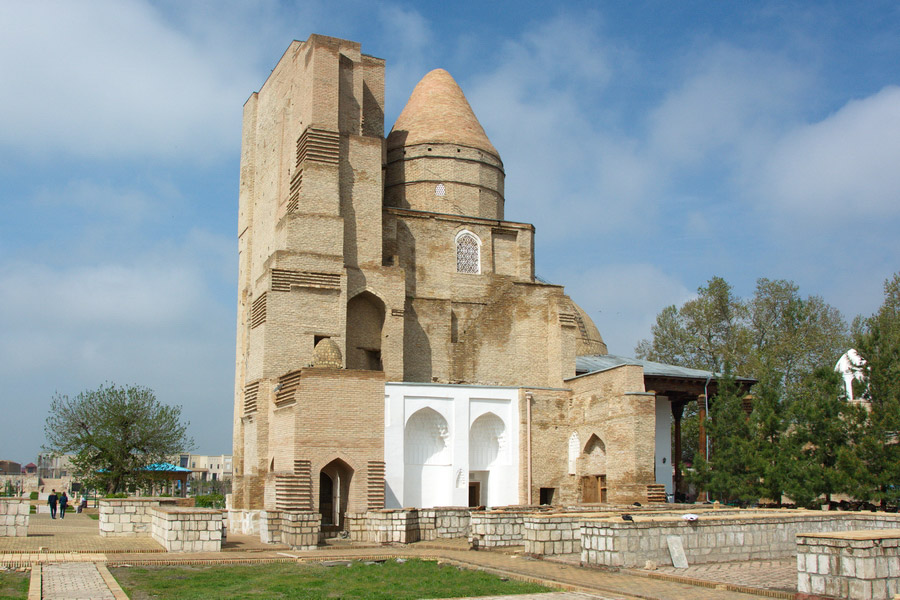
EnsemblDor-us Siyodat
Le complexe commémoratif Dor-us Siyodat («dépositaire du pouvoir») était destiné à toute la dynastie timuride et a été fondé après la mort prématurée du fils aîné de Timur, Jakhongir, en 1376. Après sa mort, son corps a été déplacé de Samarkand à Shakrisabz, la patrie historique des ancêtres.
Plusieurs années plus tard, Timur a appelé les meilleurs architectes et artisans de Khorezm et leur a ordonné d'ériger la tombe du prince le Mausolée de Jakhongir. Le chroniqueur de la cour de Timur, Sharafiddin Yazdi, a écrit: «Du côté droit et du côté gauche de la façade de cet édifice, il a ordonné que la construction de makbarats (voûtes funéraires) et d'une nouvelle khazira soit achevée pour l'émir-zade Jahangir et autres descendants et nobles.
Le deuxième fils de Timur, Umarshaykh (Omar Sheikh), qui a été tué en 1393-1394 lors du siège de la forteresse des Kurdes en Iran, a également été enterré dans le complexe Dor-us Siyodat en Mausolée Omar Sheikh. Le tombeau destiné à Amir Temur est resté vide, car le sort voulait qu'il soit enterré à Gour-Emir à Samarkand.
Les bâtiments Dor-us Siyodat ont été détruits lorsque les forces du souverain cheybanide Abdullakhan II sont entrées à Shahrisabz dans la seconde moitié du XVIe siècle, seul le mausolée de Jakhongir a survécu. La mosquée à plusieurs chambres de Khazrati Imam avec une salle en dôme et un ayvan peint, ou véranda surélevée, a été construite à côté d'elle au milieu du XIXe siècle.
Temur ordered to build a crypt soon after the construction of the complex itself. The crypt was located in the ground, and the entrance to it was carried out through a magnificent land building, made in the same style as the tombs of his sons. Steep staircase descent led to a cross-shaped room, the center of which was a room of a rectangular shape. Everything was done modestly, which did not correspond to the character of the ruler.
Apparently, the construction simply was not completed due to some unknown reason. The walls, floors and vaulted ceilings, forming a small dome, are made of white marble slabs. On the walls, in the hollowed out arches are visible ellipsoidal medallions, inside of which beautiful inscriptions are written with a beautiful calligraphic handwriting. Basically these are excerpts from the Koran, texts of prayers, various sayings. The following quotations can be considered as fundamental: “The Board belongs only to Allah”, “Only Allah is eternal”, “Good is in the hands of Allah, and only He is all-powerful and mighty.” In the middle there is a marble sarcophagus, covered with a thick monolithic plate with a thickness of more than 10 cm.
In the corners, as well as in the center of the plate, there are steel rings intended for its installation. On the plate were inscriptions, consisting of Temur’s letters and relating to his life. On this basis, it can be confirmed that this place was intended for burial of the lord. But fate ordered otherwise, this vault was destined to remain empty, for Tamerlane was buried in the capital Samarkand, in the Gur-Emir complex, which in translation means “the tomb of the ruler”.