
 3, Pushkin str., Samarkand 140100 Uzbekistan
  +998 90 655 05 00
  info@sacredeasttravel.com


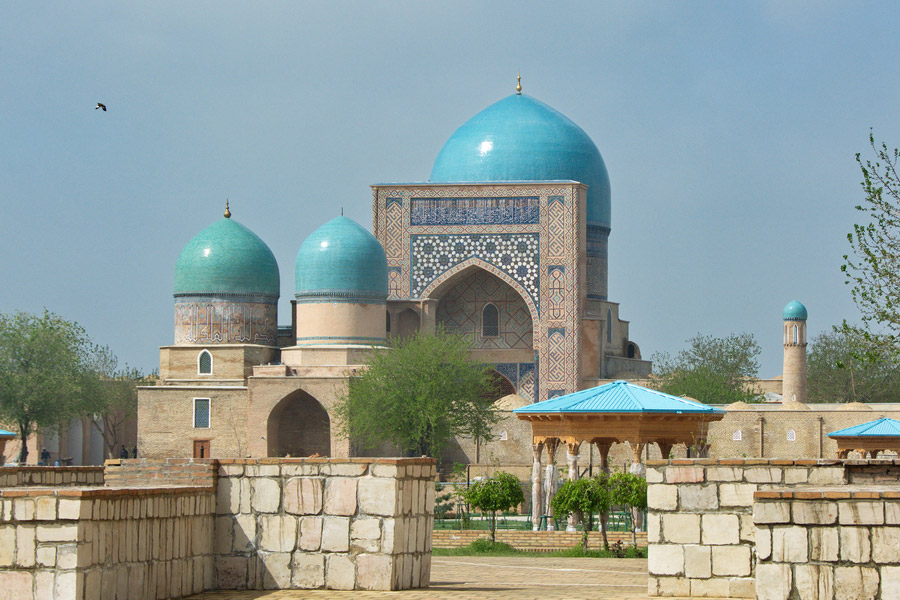
Mosquée Kok Gumbaz
La mosquée Kok-Gumbaz a été construite dans le complexe du mémorial Dorut-Tillavat juste en face du mausolée Shamsiddin Kulol en 1435-1436. C'est la plus grande mosquée du vendredi à Shakhrisabz. L'inscription sur le portail annonce que la mosquée a été construite par Ulugbek au nom de son père Shakhruh.
Le bâtiment de la mosquée est couronné par un immense dôme recouvert de carreaux de céramique bleue. Il a donné le nom à la mosquée - Kok Gumbaz qui signifie «Blue Dome». Autour du tholobate du dôme, il y a l'inscription avec des carreaux émaillés blancs: «La souveraineté appartient à Allah, la richesse appartient à Allah».
L'espace interne de la mosquée Kok-Gumbaz est presque carré dans sa disposition et comporte quatre niches profondes soigneusement orientées vers chaque coin de la terre. Toute la surface du mur était recouverte de stuc ganch et peinte de complexes ornements bleu foncé et bleu clair.
The spherical blue dome is covered with a ceramic tile of sky-blue color, which symbolizes a cloudless sky over the vast possessions of the ruler. From a distance, merging with the sky, it resembles a balloon, creating the illusion of lightness and flight. Below, encircling the base of the dome, stretches a light stripe, crowned with fragments from various suras of the Koran. Derived beautiful calligraphic handwriting, so characteristic of the Temurids era, it includes many wise and well-known sayings. Here is the most colorful and large: “Power and wealth belong to Allah. Only Allah has domination. ”
Entering the building, we see that its inner part is square. Immediately in a different way, the swing and dimensions of the dome are felt. Heavy and majestic, he hangs high above the heads. The diameter of the dome is 46 meters. Here, the sounds of voices and actions come to life and, merging, are transformed into a bizarre and simultaneously formidable echo. At the corners of the massive walls are arranged four spiral staircases, which lead to the upper level, to the rooms and the roof.
The surface of the walls inside the mosque is covered with white ganch (a mixture of gypsum and clay). In some places there are the finest painted ornaments and patterns, made in blue-blue tones. Near the walls are niches, oriented to the sides of the world.