
 3, Pushkin str., Samarkand 140100 Uzbekistan
  +998 90 655 05 00
  info@sacredeasttravel.com


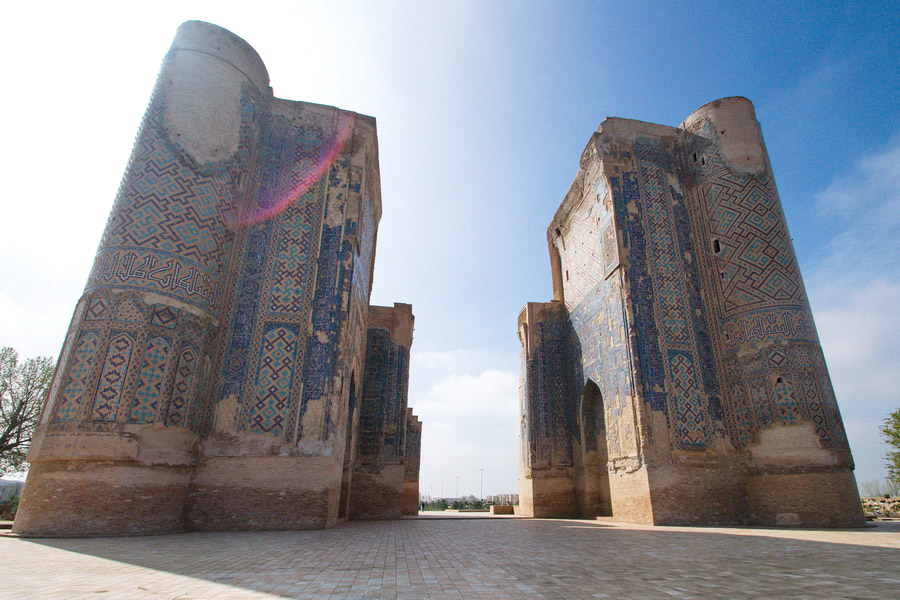
Ak-Saray palace
Today Shakhrisabz has far outgrown the medieval borders, but, as before, it is buried in the emerald greenery of the gardens, and above them, as if escaping from the depths of the sea, the magnificent creations of architects of the fourteenth and fifteenth centuries rise. It is common knowledge that a country, city or village gain popularity and universal acceptance due to some historical landmark, event or other peculiarity, which becomes its original visiting card. Shakhrisabz is primarily associated with the Ak-Saray palace. A lot of amazing legends are associated with the history of the erection of the palace. According to one of them, Temur, conceived to build a majestic building, called for an architect and set out his goal. The architect, after listening to the ruler, asked permission to admit him to the state treasury. After receiving permission, the master in front of Temur began to make blocks for the foundation of clay mixed with gold.
Seeing the imperturbability of the ruler, he broke the blocks and returned the gold to the treasury. To Temur’s question: “Why did you do this?” – the architect replied: “To be sure of the firmness of the ruler’s intentions to start building a building that requires huge expenses.” The second legend says: after the completion of the basic construction works Temur began to rush the masters with the execution of the artistic decoration of the palace. But the latter did not hurry to cover the building
majolica and mosaic. And when the angry ruler ordered the lead architect, it turned out that he disappeared, hanging a chain in the center of the main arch of the palace. Since he could not find an equal master, the building was not completed. And after some time, the architect suddenly appeared and, making sure that the chain on the entrance arch was significantly lowered, proceeded to the decorative decoration of the palace.
To Temur’s formidable demand to explain his so strange flight and sudden appearance, the architect replied: “I did not dare disobey the decree of the ruler, but I could not fulfill it, and in either case a severe punishment awaited me, for such a majestic building must settle firmly to settle in the ground, otherwise all the applied ornament would be destroyed. ” The great ruler appreciated the wisdom and resourcefulness of the master. “If you doubt our strength – look at our buildings.” Such an inscription adorns the portal of the majestic palace of Ak-Sarai, built by the great commander.
Amir Temur in the 14th century. Unfortunately, only part of the entrance portal of the palace has survived to this day, but even the remnants of this portal help to present the unprecedented beauty and grandeur of this building. Temur built it on a bare field, driving 50,000 captive architects and masters from all corners of his empire: from Khorezm, Iran, Iraq and Northern India. There is a legend that when preparing the first bricks for the royal building added golden sand!
According to the plan of the Bishop, the structure was to be unsurpassed in its grandeur. The scale of construction was truly royal. The Great Sovereign did not regret money. He certainly wanted his buildings to be the largest and best in the sublunary world.
According to descriptions of contemporaries and on materials of archaeological research, scientists recreated the layout and artistic appearance of Temur’s palace. Although Ak-Saray is translated from Uzbek as “White Palace”, however in the name of the palace it means “noble, aristocratic”. Striking, first of all, the scale of the building. Only the front yard, whose plan was recovered, occupied 250 meters in length and 125 meters in width. And the height of the main portal, crowned with arched teeth, reached 70 meters – the size of a twenty-story building. Corner towers in height were not less than 80 meters, and the entrance arch had a span of more than 22 meters. In August 1404, the Ak-Sarai Palace was visited by the Ambassador of the Castilian King, Gonzalez de Clavijo. He described it as follows:
“The palace has a very long entrance and very high gates, and here, at the entrance, there were brick arches from the right and left sides, decorated with tiles laid out with different patterns. And under these arches were like small rooms without doors, that is [grooves] with the floor laid out with tiles, and this was done so that people could sit there when the seigneur was in the palace. Immediately behind these gates was large courtyard paved with white slabs and surrounded by richly decorated galleries; and there is a large pond in the middle of the courtyard, and this courtyard occupies three hundred paces in width, and through it entered the largest room of the palace, which was led by a very large and high door, decorated with gold, azure and tiles-all very skillful work. And above the door in the middle was a lion [on the background] of the sun, and on the edges exactly the same images. It was the coat of arms of a lord of Samarqand. ”
The palace served for recreation and entertainment, as well as for the administration of state affairs. On the axis of the courtyard was located a dome-covered room for meetings of the sofa – the State Council. It had on both sides small meeting rooms of advisers – Tashadjibek and Devonbek. Among the palace buildings there was also a harem, richly decorated and lavishly trimmed. In front of him was a shady garden with ponds, lined with patterned tiles.
The arch of the entrance portal of Ak-Sarai, which collapsed 200 years ago, was the largest in Central Asia. The span of the portal was 22.5 m. From this majestic structure there were two separated pylons. The height of these pylons, even in the present destroyed state, reaches 38 m. A great deal of work continues on the restoration and strengthening of the pylons of the portal portal. The mosaic of filigree work, gathered in a complex color scheme, amazes with bright intricate ornamentation and paintings. The part of the pylons and the monumental arch, which has survived to this day, amazes with the dimensions – with a height of 18-storey house and a width of about 20 meters.
Ak-Saray Palace is the largest complex of civil architecture not only in Central Asia. The destruction of the historical building is attributed by the historical tradition to the Bukharian Emir Abdullahan II, who, at the next siege of the defiant Shahrisabz, allegedly ordered to break magnificent buildings Temur and his descendants. Wishing to erase the memory of his famous predecessor, no matter how hard he tried, he could not destroy the palace to the end. Whatever it was, but already in the second half of the XVIII century. from the once luxurious royal palace only pylons and part of the arch of the main portal have been preserved. The construction of Ak-Saray Palace embodied the idea of Sakhibkiran to transform Shahrisabz into the second capital of the state, and the creation of Dorus-Syodat and Dorut-Tilovat memorial complexes reflected his desire to make his native city the spiritual center of Mavarounnahr.
During the years of independence of Uzbekistan, restoration work was carried out on the surviving parts of the palace. Along with other monuments of Kesh in the Timurid era, the palace is listed as a UNESCO World Heritage Site.