
 3, Pushkin str., Samarkand 140100 Uzbekistan
  +998 90 655 05 00
  info@sacredeasttravel.com


The history of Uzbek arts and crafts can be compared to the flow of the Central Asian rivers Syr Darya and Amu Darya. The upper reaches of these rivers lie high in the mountains, in the land of glaciers and fogs. At the mountain foot the streams meet to form rapid rivers, which rush to the plains where they finally slow down irrigating fields and feeding reservoirs. Similarly, the history of Uzbek arts and crafts began centuries ago, undergoing both rapid and slow periods of development. But the chain of those development stages has never broken – the artistic tradition has always been maintained.
The works of Fergana, Samarkand, Bukhara, Khiva and other masters have been historically notable outside the country and still continue to stir interest of lovers of the beautiful from all over the world. Each region has its own direction. Chust, Namangan region, is widely known for its skullcaps and knives; Rishtan, Fergana region, turquoise ceramics; ancient Margilan, satin with iridescent play of colors; sacred Bukhara, gold embroidery. Throughout the centuries, the national Uzbek crafts and arts have both risen and declined, but the handing down of artistic traditions from one generation to the next has never stopped.

Ceramic
Ceramic for many centuries has been the most highly developed kind of trade in Central Asia. Traditional centers of ceramic, which remained till today, are: Rishtan, Gijduvan, Khiva, Samarkand, Gurumsaray, Shakhrisabz, Urgut, Khorezm and Tashkent. Pottery of these centers is clearly divided into two color groups: the first is dominated by blue, green and white colors, while the second – green, brown and yellow. In Samarkand, Tashkent and Bukhara a lead glaze is used so here is wonderful turns the whole range of red and brown. Each ceramics center also has a unique decorative style. The masters of Samarkand school restore the traditions of vessel decoration by modeled elements in the form of animals and birds heads. Rishtan ceramics is the most famous in Uzbekistan. Its main feature – a bright blue glaze – “ishkor” – a dye derived from the plant ash. In Rishtan the oldest masters and representatives of young generation have brilliant technical skills such as moulding (masters – kuzagars) and painting (masters – nakkoshi). The repertoire of ornamental patterns in Rishtan ceramics is one of the richest in the world. There are geometrical and plant patterns, signs and symbols, and images of various subjects. Contemporary works of Rishtan masters, the real embodiment of the traditions of blue ceramics of Temurids’ epoch, are exhibited in the museums of Italy, Hungary, France, Belgium, Russia. In recent years the works of Nabidjon Kadirov, follower of Usto Ibragim Kamilov, Rustam Usmanov, Sharafutdin Ysupov, Makhmud Azizov have been displayed in the exhibitions of Switzerland, Germany, Japan and other countries. The tradition of making clay toys, an attribute of ancient cultural ceremonies, comes back. This kind of craft, which was typical for Bukhara and Samarkand ceramic schools in past, almost disappeared.
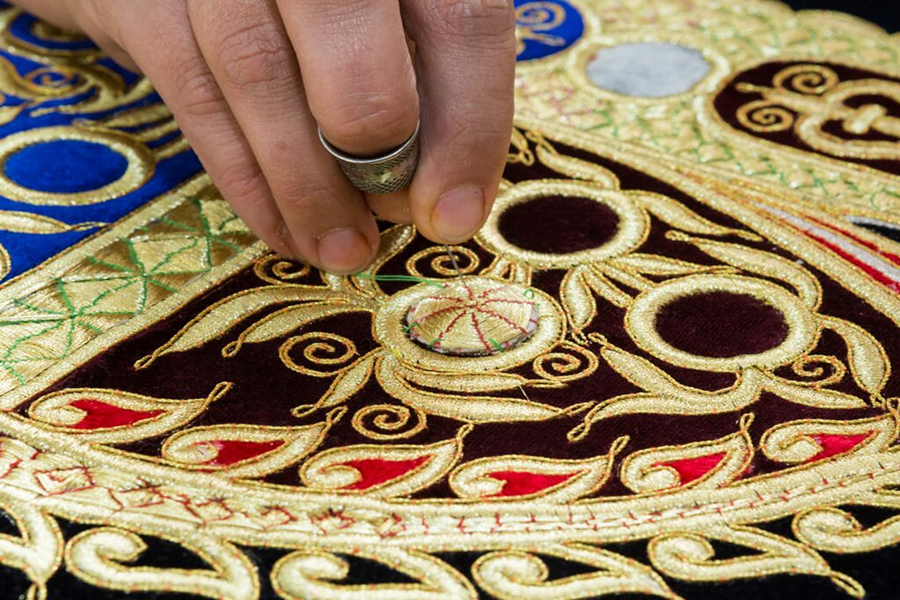
Gold Embroidery
Gold embroidery is embroidery with gold and silver thread — a very ancient kind of needlework. Historical records give the evidence of the existence of gold embroidery as early as in the Middle Ages. This kind of needlework was wide-spread in many parts of the world, and Uzbekistan was not an exception. However, its special embroidery techniques and national patterns make the golden-embroidered products a unique and original. The art of gold embroidery, zardozi, has been existing on the territory of Uzbekistan since ancient times. Gold embroidery decorated ceremonial clothes, hats, shoes, accessories horse outings. General terminology used by masters of gold embroidery business calls embroidery thread as “kalebatun.” To indicate the type of yarn it is prefixed with “tillo” (for gold thread) and “safid” (for silver one). Three main types of compositions of embroidery in gold, known as “daukur”, “butador” and “darkham”, became historically established by the XIX century. With the “daukur” composition the design of the fringe corresponded to the pattern of the medallion on the back of the robe, though enlarged in proportion and made up of elements included. This peculiar arrangement was not typical of the masters of Bukhara. Articles with a “butador” composition were very expressive and smart. The flowers on bushes were executed m bright appliques; the emerald-green leaves were sewn with the “shirozi” stitch, which brought on amazing iridescence. In the composition of darham the ornament of the central field is a continuous pattern. Its contours are trimmed with the technique of takhrir – framing with a thin cord of gold twisted threads, or kobuli (Kabul sewing) – with threads in the form of small round loops connected together.
Gold embroidery in Bukhara has a style of its own, and its best specimens came into being where the great masters found patterns which were logic in composition, figurative in needlework and masterly performed. Typical Bukhara design consists of flowers on thin branches evenly distributed over the surface of cloth, or round rosettes with long stems. Colors consisted of harmonious combination of blue, grey and light yellow with red, raspberry and green. Secrets of golden-embroidered art were passed from generation to generation and were not affordable for strangers. Now women are doing this work so skillfully, that Bukhara golden-embroidered goods became known all over the world.
The basic cloth for Uzbek gold embroidery is velvet of different colors, which makes the gold threads of the embroidery especially shaded, emphasizing every stitch and intricate pattern.
Over the whole history of its existence, gold embroidery has been developing universally in Nurata, Shakhrisabz, Samarkand, Jizzak, Tashkent, Fergana and Pskent. However, it was particularly developed and widely spread in Bukhara in the mid XIX century, in the workshops at the palace of the Emir of Bukhara, where skilful masters were embroidering garments of the ruler and his courtiers. And up to now, the Bukhara gold embroidery is famous even outside Uzbekistan.

Carpet Weaving
One of the oldest types of folk art in Central Asia is the production of silk and woolen carpets. Ancient traditions of Uzbekistan carpet weaving are revived today in many regions of Uzbekistan. Bright, original, intricate patterns, distinctive color (from red-brown to red-blue), brightness, and countless options of patterns and ornament made local carpets renowned in many countries. Carpet is a symbol of a family’s wealth and prosperity. Depending on the region, carpets are distinguished by color and ornaments. For example, Samarkand carpets have black, red and blue tones. Bukhara carpets are decorated by multicolored patterns. There are red and blue stripes on the carpets in Fergana valley. Khiva carpets are mostly made from plant patterns. Today there are three methods of production of carpets used in Uzbekistan:handmade carpets, those made at a plant and carpets made at a small private factory. Homemade carpet weaving develops in the Fergana Valley, Nurata Mountains, Kashkadarya, Surkhandarya, Syrdarya regions, Karakalpakstan. The Uzbek carpet weaving centers for production and marketing are also Samarkand, Urgut, Kokand and Khorezm. Craftsmen produce long pile and short pile carpets (dzhulhirs, gilyam), pileless carpets (rugs). The characteristic feature of short pile carpets is their red-brown tint, lit up by the harmony of light-colored details of the principal medallions, which usually appear in geometrical shapes. Carpets are divided into several species along the length of the nap: long-carpet rugs “dzhulkhirs”, short-carpet rugs “gilams” and lint-free carpets “palas”.Original long-sleeved carpets – dzhulkhirs with elegant joyful color today are the glory of Samarkand craftswomen. Ornaments of Uzbek silk rugs, created by craftswomen many centuries ago, once had a magical significance. They are based on stylized plant and zoomorphic motifs, magic symbols and totem signs. Having planned a tour to Uzbekistan, particularly, Samarkand, you should visit the carpet factory “Khudjum”, where this famous silk hand-made “miracle” has been produced.

Wood carving Art
From times immemorial such wood articles as jewelry boxes kuticha, book holders — lavhi, carved tables were traditional for the East. All of them show all the beauty and wealth of traditional floral and geometric ornament. Great experts work in this domain of art, preserving the experience of the past and bringing innovations into their work. Patterned wood carvings often cover architectural elements – pillars, beams, cornices, doors, as well as smaller objects, such as low khantakhta tables, trunks, boxes, Koran stands, book-holders, kalamdon pencil-cases, musical instruments. Khiva, Bukhara, Samarkand, Tashkent and Fergana have been and still remain acknowledged centers of wood carving in Uzbekistan . Each school is distinguished by its technique and carving patterns.
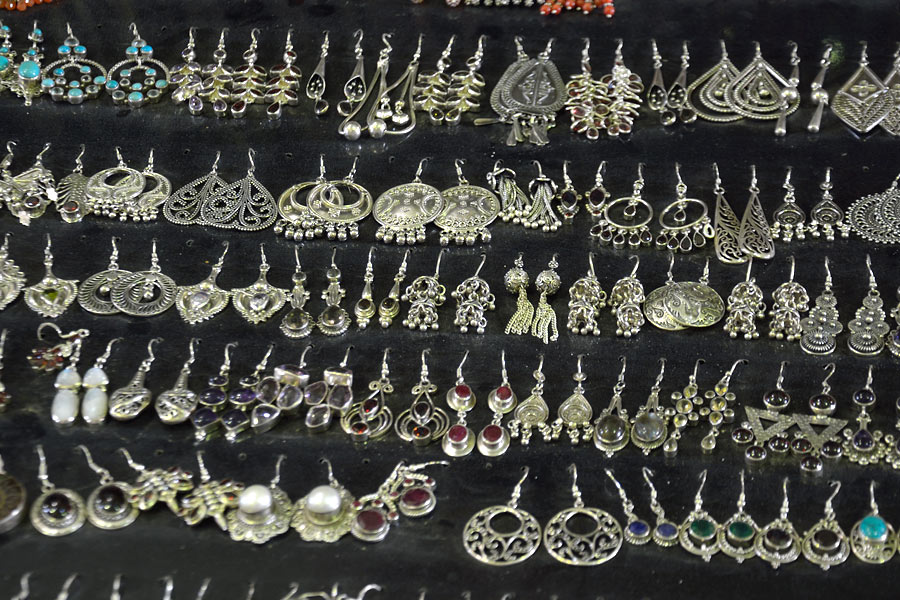
Uzbek jewelry
Many Uzbeks believe that jewelry with natural stones serve as talismans and bring good luck. For example, silver protects from evil spirits, protects from poison and symbolizes purity. Pearl – heals from serious illnesses and gives strength. Turquoise brings good luck in business. Carnelian stone, Uzbeks call it khakik, bestows health and happiness. Many other stones and metals were also endowed with magical properties.Thanks to the painstaking and skillful work of the masters, the jewelry art of Uzbekistan continues to develop. The traditions of forefathers, combined with the skill of modern masters, continue to live in delicious and unique jewelry.

Knives
A less prominent though important branch of metal – working in Uzbekistan is the art of knife – making. Pichok or pchak – the Uzbek national handmade knife – from time immemorial meant more than just a tool or a combat weapon. The knives are highly sharpened and kept in leather sheaths decorated with metallic plates, embroidery, appliqué or painting. Such knives are called ghuldor pichok, meaning “elegant, decorated knife”. The forms are various. The blades differ according to where they are made: narrow or wide, straight or curved, as do the shafts; single – piece or composite, wooden or bone, encrusted or painted. The craft is still respected, and the products are popular. The master of Shakhrikhan, Andijan, Chust, Bukhara,Samarkand and Tashkent are especially famous for their pichoks.Of the ancient centers of artistic knife – making remain Chust in the Fergana valley, Khiva and the well known black smiths in Bukhara. Chust knives are distinguished by their lightness and elegance, the tip of the blade is curved upward and the “nose” of the handle is slightly folded down. Masters will always offer you a large selection of knives: with threaded, patterns, with bone or wooden handle, and also with a handle made of horn. There is an inscription on the blade of the knife: “Estalik Uchun Chust”, which means “In memory of Chust” and its leather case are decorated with simple form embroidered patterns, but the whole attractiveness is in this simplicity.
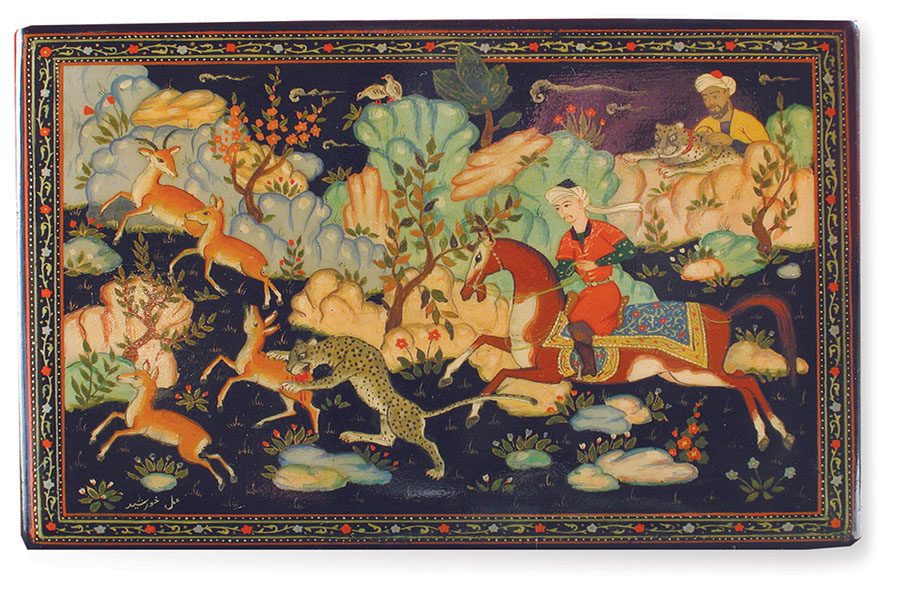
Lacquer Painting
Though many secrets of Uzbekistan lacquer miniature were lost, modern Uzbek artists and craftsmen succeeded in revival of this art, creating own painting style and keeping centuries-old principles and forms of lacquer miniatures. In current lacquer painting traditions the technology of Palekh and Oriental miniature painting is used. Mainly, lacquer painting decorates various small wood boxes, pencils boxes, tables, chesses. Uzbek lacquer paintings is made by natural dyes, stirred with the egg yolk.
Today articles with lacquer painting are Uzbekistan traditional souvenirs. Moreover, beautiful miniature lacquer painting of modern Uzbek artists is displayed in various exhibitions and museums within Uzbekistan and abroad.