
 3, Pushkin str., Samarkand 140100 Uzbekistan
  +998 90 655 05 00
  info@sacredeasttravel.com


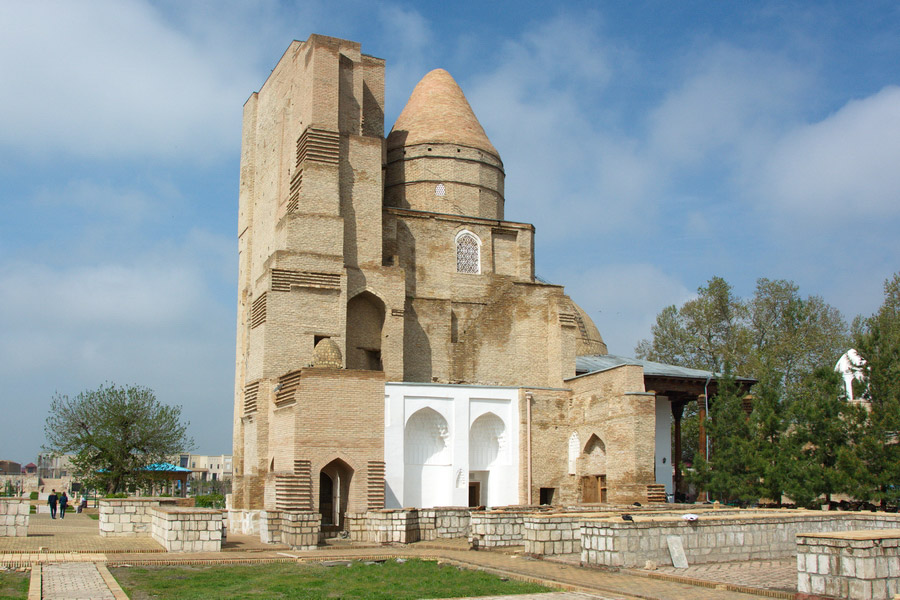
Dorus-Syodat Memorial Complex
Dorus-Syodat Complex is one of the most romantic and mysterious architectural ensembles in Shakhrisabz. When the youngest son of Amir Temur – Jahongir suddenly died in Samarkand at the age of 20 years, the king was very upset. He loved his son madly and prepared him for the heirs of the throne. Jahongir also pleased his father with successes at the training bureau in the madrassah, and also showed courage on the battlefields. He summoned the best architects from different cities, including Khorezm. His desire was to build a majestic structure in the homeland of his ancestors – in the city of Shakhrisabz. The complex is called Dorus-Syodat. This memorial complex was intended not only for prince Jahongir, later he began to act as a family crypt for part of the Timurid dynasty.
A short time later, a second son, a twenty-nine-year-old Umarshah, was buried there, who fell in battle (1393-1394) during the siege of the Kurt fortress in Iran. His body was transported from the city of Shiraz here, to Shakhrisabz. Construction lasted from the late 14th to early 15th centuries. At that time, Temur wanted to give Maverannahr the status of the largest empire in the East not only with vast possessions, but also with a rich cultural heritage. Shakhrisabz began to take on the appearance of a spiritual center, the cultural core of this part of the East. There used to be a large number of bright minds, among them famous scientists and poets: Alisher Navoi, Jami, Mirzo Ulugbek. The latter even lived here for a while, comprehending the wisdom of this city. All this was reflected in the image of Shahrisabz, most of which is its unique architecture. Dorus-Syodat is no exception. The court historian and chronicler Sharafiddin Yaazdi left written data in his work “Zafarname” (“Book of Victories”):
Up to the present day, materials of other ancient authors have also reached, according to which the height of Dorus-Syodat at the highest point – the outer dome – reached 27 meters. The front arch had a powerful portal, through niches of which it was possible to distinguish painted patterns, epigraphic runes, stretching with a long ribbon throughout the building of the front part of the building. The facade of the building was faced with a majolica of different colors, but the main role was played by the blue color and its shades. The remaining colors favorably stand out against its background, creating a beautiful artistic image. Entrance door of massive size was covered with tiles, harmoniously adjacent to the ornaments of gold and azure. The colorfully decorated building evoked delight and admiration from all who were there. One of the parts of the complex was assigned to a madrassah. At the entrance to the main portal one of the corridors led to his yard. Madrassah Dorus-Syodat initially did not serve for education and education of citizens, it was more like a mosque, where religious activities, religious services and rites of remembrance were performed. By the decree of Temur himself, the time from time here they brought a sacrificial gift in the name of the repose of the souls of Jahongir and Umaršehaj.
Inside the courtyard, along its perimeter were the rooms where the ministers of the madrassa lived, as well as some of the members of the clergy in the manors built here. In the center was a flowering garden with fountains and aivans. Under the cool murmur of fountains in these shady gardens, many sages and priests found themselves. To this day, preserved stone-paved floors, which were niches of aivans and vaults of walls adjacent to the portals. Behind the Dorus-Saodat complex there is another part of it – the crypt of Amir Temur. According to one version, in 1943 a local boy, chasing a ball, fell into the ground. Thus was discovered the crypt of Tamerlane. Subsequently, archaeological excavations were launched here, during which the scientists restored and restored part of the crypt.
Temur ordered to build a crypt soon after the construction of the complex itself. The crypt was located in the ground, and the entrance to it was carried out through a magnificent land building, made in the same style as the tombs of his sons. Steep staircase descent led to a cross-shaped room, the center of which was a room of a rectangular shape. Everything was done modestly, which did not correspond to the character of the ruler.
Apparently, the construction simply was not completed due to some unknown reason. The walls, floors and vaulted ceilings, forming a small dome, are made of white marble slabs. On the walls, in the hollowed out arches are visible ellipsoidal medallions, inside of which beautiful inscriptions are written with a beautiful calligraphic handwriting. Basically these are excerpts from the Koran, texts of prayers, various sayings. The following quotations can be considered as fundamental: “The Board belongs only to Allah”, “Only Allah is eternal”, “Good is in the hands of Allah, and only He is all-powerful and mighty.” In the middle there is a marble sarcophagus, covered with a thick monolithic plate with a thickness of more than 10 cm.
In the corners, as well as in the center of the plate, there are steel rings intended for its installation. On the plate were inscriptions, consisting of Temur’s letters and relating to his life. On this basis, it can be confirmed that this place was intended for burial of the lord. But fate ordered otherwise, this vault was destined to remain empty, for Tamerlane was buried in the capital Samarkand, in the Gur-Emir complex, which in translation means “the tomb of the ruler”.