
 3, ул. Пушкина, 140100, г. Самарканд, Узбекистан
  +998 90 655 05 00
  info@sacredeasttravel.com


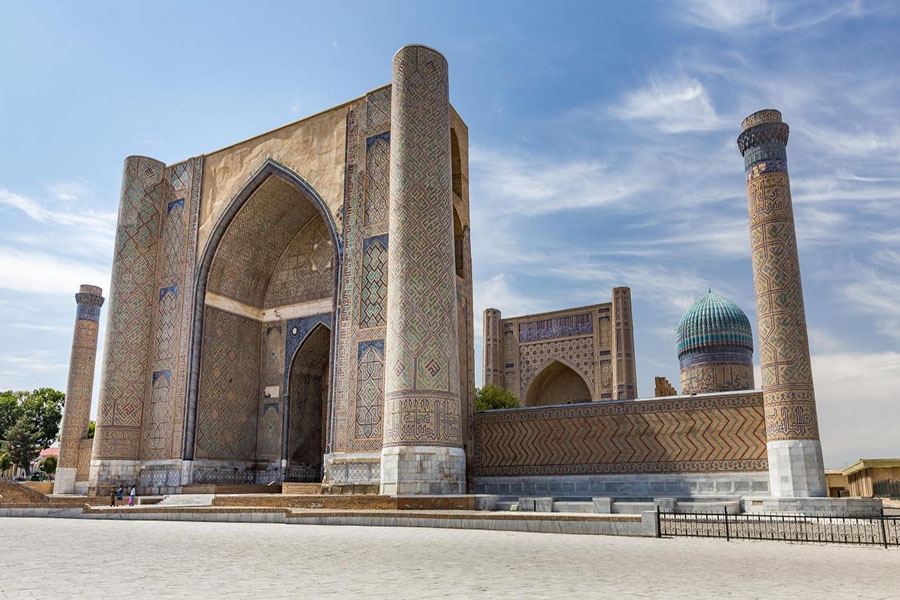
Мечеть Биби-Ханым
Строительство мечети было начато в 1399 году, после победоносного похода Темура в Индию. Мечеть строилась в течении пяти лет. Сооружение было завершено в 1404 году. По замыслу Темура мечеть Биби-Ханым должна была затмить все виденное им в других землях. К участию в строительстве были привлечены зодчие, художники, мастера и ремесленники из многих стран Востока. Мастера и ремесленники, согнанные и собранные со всех концов мира, вносили в строительство свой творческий опыт и традиции. Обширный внутренний двор выстлан мраморными плитами и обнесен крытой галереей для богомольцев. Улугбек установил внутри главного здания громадный мраморный пюпитр, предназначенный для Корана и пере-ставленный в 1875 году на середину двора.Вход во двор оформлен в виде высокого портала с двумя круглыми минаретами, достигавшими пятидесяти метров высоты.
Many buildings, of which the mosque originally consisted, were combined into a single composition by a covered gallery with 480 marble columns and occupied an area of more than 18,000 square meters. On the east side of the rectangular courtyard was located the peshtak – the main entrance portal 33,15 meters high and 46 meters wide. Opposite the portal in the center of the complex stood the main mosque, the entrance to which was adorned with double doors, poured from seven alloys, carved marble slabs and skillfully made lining. At the corners of the mosque, four tall multi-level minarets were built. In the center of the courtyard a deep well was dug and covered with stone tiles with a hole for water drainage (tashnau). The Bibi Khanum Mosque was conceived as a structure that was supposed to far surpass all similar buildings. However, the medieval masters did not own the technologies and materials necessary for building such large-scale buildings, besides; they did not take into account the risk of seismicity. Deep foundations of torn stone and brick walls did not save Bibi Khanum – even during Timur’s lifetime the building began to collapse, and the stones from the cracked dome poured onto the heads of the prayers. Now from the whole complex you can see only five surviving buildings: a portal, a large mosque in the backyard, two small mosques and a minaret. In addition, the center of the courtyard is still adorned with a huge marble music stand for the Holy Quran, made at Ulugbek.
But thanks to the painstaking work of historians, archaeologists and art historians, we have the opportunity to present the original appearance of Bibi Khanum. The finest geometric, vegetative and epigraphic ornaments, as well as majolica combined with inorganic bricks and carved mosaic decorate the building of the mosque. On the inside of the dome were gilded papier-mache products, and on the walls – ornamental painting on plaster. Small mosques have a more modest decor – this was done intentionally, to better emphasize the importance of the main building.
In 1968, work began on the restoration of the complex Bibi Khanum, but the residents and guests of Samarkand could see almost completely the restored structure only by the beginning of the 2003 tourist season. Again, the arch of the main portal, which was destroyed about half its height, was rebuilt. The lower marble frame remained original, and the old veneer is immediately visible – it is darker. Just like on the main mosque, the original ornament is darker than the modern reconstruction, which is 90%. The partially preserved north-western minaret was completely lined, and three other minarets were rebuilt, rebuilding and lining. At the same time, the height of newly built minarets is less than that of those built by craftsmen in the 15th century. The dome of the main mosque and the dome of the side mosques were also completely restored. Today, the reconstruction work in Bibi Khanum continues, across the street from the mosque, there is an original monument – an octagonal pillar-shaped mausoleum by Bibi khanum with a crypt. This building has no main facade, and judging by the tiled and painted decor, the mausoleum was attached to the Bibi Khanum mosque. The frame of the mausoleum testifies that it was erected at the same time as the mosque. Marble sarcophagi are placed in a spacious vault on the floor. When in 1941 the sarcophagi were opened, they found the remains of two richly dressed middle-aged women. It is possible that one of them was Sarai Mulk Hanum, she is Bibi Khanum.
Separately I would like to note the bazaar, which is located near the Bibi Khanum mosque. After 900 years, he did not lose his colour and still continues to live his unique life of the oriental bazaar.