
 3, ул. Пушкина, 140100, г. Самарканд, Узбекистан
  +998 90 655 05 00
  info@sacredeasttravel.com


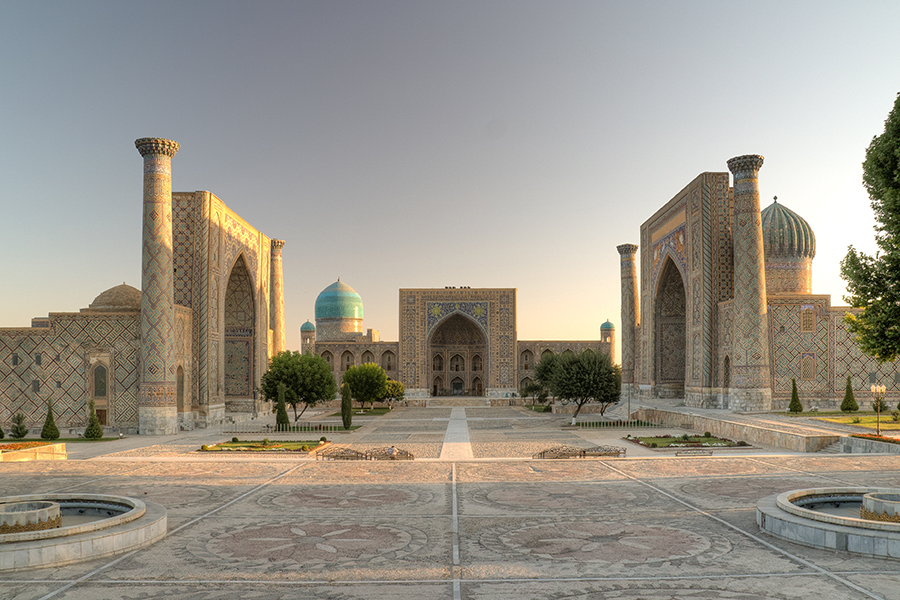
Регистан
В XIV веке центральной площадью Самарканда стал Регистан, что в переводе означает «песчаное место». К Регистану радикально сходились шесть главных улиц города. Архитектурный ансамбль Регистан, считается ведущим в Центральной Азии и величайшим среди грандиозных дворцы, Гур-Эмир, Биби-Ханым, ряд мавзолеев ансамбля Шохи-Зинда, которые до сих пор поражают своей красотой и величием. Самарканд утопает в садах, а окрестности застроены селениями с именами таких величественных столиц мира, как Миср (Каир), Димишк (Дамаск), Багдад, Султания, Фариш (Париж). Его дело продолжит его внук Улугбек - великий учёный, правление которого империей пройдёт под девизом "Стремление к знанию обязанность каждого мусульманина". Основным вкладом в развитие науки Улугбека является его медресе на площади Регистан и обсерватория, не имеющая равных себе в то время. Улугбек составил точный атлас небосклона из 1018 звёзд, "Гургановы"таблицы, а также каталог географических координат большого числа пунктов на Земле. Вместе с Улугбеком трудится его ученик и соратник Али Кушчи, который высчитал "Пи" с точностью, которую превзойдут только через 250 лет.
Медресе Улугбека Медресе вмещало, по меньшей мере, 100 студентов под крышей хорошей школы по преподаванию исламских и священных наук. Его размеры гармонично сочетаются с абсолютной элегантностью его дизайна и черепичного покрытия. После входа вы попадаете во внутренний двор. Который ведет к четырем аркам, плавно переходящий в 2 ряда худжры.
Rectangular in terms of madrassah had four aivans and a square courtyard, along the perimeter of which were located deep niches, leading to two-tiered cells, where students lived. The back side of the courtyard was occupied by a mosque, four domes towered above the corner educational auditoriums of the madrasah, and four minarets were located at the corners of the building. The building is facing the square with a majestic eastern portal with a high pointed arch, above which there is a mosaic panel with geometric ornamentation, made of colored bricks, irrigated and carved ceramics. Madrassah Ulugbek was one of the best spiritual universities of the Muslim East of the XV century.There studied the famous poet, scholar and philosopher Abdurakhman Jami. Lectures on mathematics, geometry, logic, natural sciences and theology were read at the educational institution and were read by their famous scientists of that time: Kazi-zade ar-Rumi, Jemshid Giyas al-Din Al-Kashi, Al- Kuschi, and also Ulugbek himself.
Медресе Шердор Второе медресе Регистана было построено губернатором Ялангтушем между 1619 и 1636 годами. Архитекторы старались в первую очередь построить сооружение достойное по своим размерам и величию, в то время как Коран запрещал симметрию полностью в зеркальном отображении.
Sherdor madrassah is almost repeats the opposite Ulugbek madrassah, although in distorted proportions. It is distinguished by an inordinately large dome, which could cause the gradual destruction of the building already a few decades after its construction. The walls of the madrassah are covered with quotations from the Koran, the emblem of Samarkand is depicted on the entrance portal – leopards with the sun on their backs, a swastika is placed in the center of the arch, and “God Almighty” is written on top of the special Arabic script. The decoration of the external and internal facades is made of glazed brick, mosaic sets and paintings with an abundance of gilding. Finishing of the Sherdor madrassa is noticeably inferior to the refinement of the madrasah of Ulugbek, erected in the 15th century, which was the “golden age” of the architecture of Samarkand. Nevertheless, the harmony of large and small forms, elegant mosaic pattern, monumentality, clarity of symmetry – all this places the madrassah on a par with the best architectural monuments of the city.
Медресе Тилля-Кари Для того чтобы дополнить гармонию площади, губернатор Ялангтуш направил свои строительные планы на возведение 75-ти метрового медресе. Строительство проходило приблизительно с 1646 по 1660 годы. Маленькие угловые башни, относящиеся к медресе, с мозаичным оформлением, в виде словно щедрых лучей солнца и переплетающихся цветочных мотивов,своей цветовой гаммой напоминает медресе Шердор. Его великолепный интерьер выполнен в стиле кундал с позолоченной надписью названияТилля Кари, выражениями из Корана и сталактидами над мраморной плитой.
To the east of the Till-Kari madrassah is Dakhma Sheybanids, which is a heap of tombstones, the oldest of which dates back to the 16th century. The founder of the Sheibanid power was the grandson of Abul Khair, Muhammad Sheibani, who in 1500 conquered Samarkand and Bukhara, overthrew the last rulers ruling there from the Timurid dynasty. After that, Sheibankhan in 1503 seized Tashkent. In 1506 he captured Khiva and in 1507 attacked Merv (Turkmenia), eastern Persia and western Afghanistan. Sheibanids stopped the offensive of the Safavids, who in 1502 conquered Akkoyunlu (Iran). Muhammad Sheibani was the leader of nomadic Uzbeks. Dakhma Shibanids is a funerary structure in the form of a rectangular prism. The grave was acquired by the order of the daughter-in-law of Sheibani Khan, the wife of his son Temur Sultan, Mihr Sultan Hanim, as a special family burial vault. Later Hamza Sultan (1511), Mahdi Sultan (1511), daughter of Sheibanikhan Shahrbanu khanim (1536) and other representatives of the Shibanid dynasty were buried. The latest gravestone dates back to 1586. Initially, the Sheybanids were buried in the Dakhma on I.Karimov street, but in the 1870s it was destroyed by order of the authorities, and the tombstones were transferred twice, for the last time transferred to the territory of Registan.
Behind Sherdor madrassa is an ancient trading dome of Chorsu, confirming the status of Registan Square as a shopping center of medieval Samarkand. The hexagonal domed building, which has survived to this day, was built in the 15th century, and was rebuilt in the second half of the 18th century [4]. By the order of Khokim of Samarkand, the future Bukhara emir from the Uzbek dynasty of manghit, Emir Shahmurad. In 2005, the commercial dome was restored, while a three-meter layer of soil was scraped off to restore the full height of the building. Now it houses a gallery of fine art, where works by Uzbek artists and sculptors are exhibited. It is said that the name of the square – a place strewn with sand – was due to the fact that the ground was covered with sand, as the main canal was passing through here. However, it should be remembered that at the time of Timur, who died in 1405, on that square there was not one of the existing buildings that are considered masterpieces of Eastern architecture.