
 3, Pushkin str., Samarkand 140100 Uzbekistan
  +998 90 655 05 00
  info@sacredeasttravel.com


Kokand
Kokand city, located in the western part of the Fergana Valley, is one of the most ancient cities of Uzbekistan. The first written records about the city Hukande, Havokande (old names of the city) were found in the chronicles of the 10th century. The town was important trade center on the Silk Road and in the 13th century, like most Central Asian cities, was destroyed by the Mongols.
The world fame came to the city in the 18th century, when it became the capital of the richest and the most developed Kokand Khanate. In the first half of 18th century near the current city (the territory of Bukhara Khanate that time), the founder of the Kokand Khans’ Dynasty laid the fortress of Eski-Kurgan (1732), which actually gave birth to new Kokand. Soon it has got its former name – “Khuk-kand” (“Boar city”). Originally it was a small possession, isolated from the Bukhara Emirate, but gradually it has expanded geographically.
The Khanate reached its power in the first half of the nineteenth century, when its territory included the major part of present-day Uzbekistan, part of southern Kazakhstan, Kyrgyzstan, Tajikistan and China. The Kokand Khanate also included Tashkent and Shymkent. It was a big, powerful state, prosperous trading and religious center. Only in Kokand there were over 300 mosques and dozens of madrassahs.
In the second half of the 19th century Bukhara, Khiva and Kokand Khanates started the struggle for power in Central Asia. Taking this opportunity, Tsar Russia has begun campaign of conquest to Central Asia. In 1868, pursuant to the contract the Kokand Khan was equated with their rights to a vassal of the Russian Empire. It was the end of the history of the Kokand Khanate, which had existed almost 170 years.
After Kokand became the part of Russia, the Khan’s palace was turned into a fortress, and new highways were laid through resident quarters – mahallas, along which buildings of European architecture were constructed. The city quickly became a major center of capitalist activity in Turkestan, surpassing even Tashkent in number of banks.
All monuments of the khan period, dating from 18-19th centuries preserved perfectly in today Kokand.
Sights:
Khudoyar-Khan Palace:
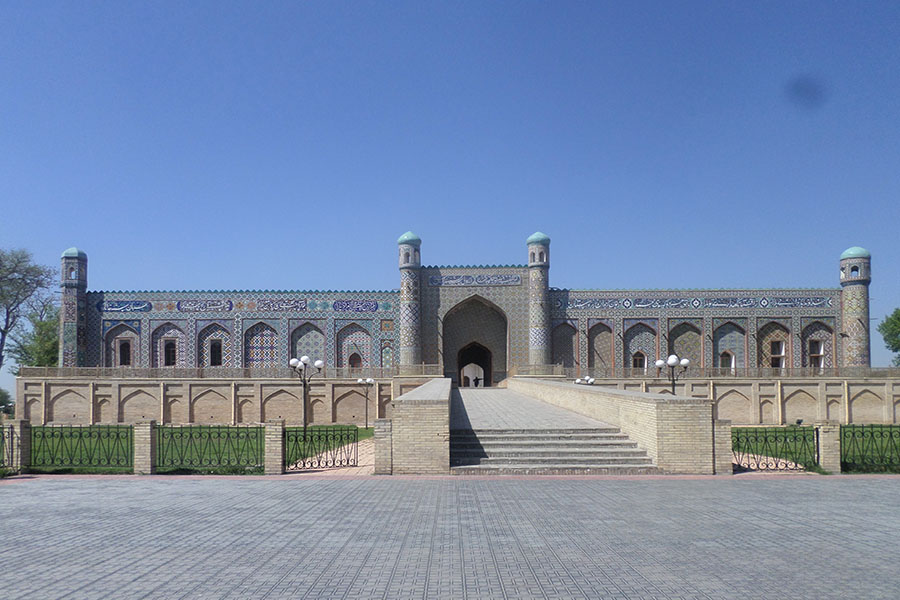
Pearl of Kokand is the palace of the last ruler of Kokand Khanate’s Khudoyar Khan. The magnificent palace complex, built in 1871, is a staggering grandeur. The palace was constructed in the traditions of Central Asian architecture with high portal in the middle, decorated with a large entrance arch and four minarets: the two of them stand on both sides of the portal, the two are wings of the facade.
Palace Khudoyar Khan, surrounded by a carved stone wall, consisted of seven small courtyards and 119 rooms. The total area of the palace was 4 acres, his foundation raised by three meters. Above the main gate was inscribed the Arabic inscription: “Great Seyed Mohammad Khudoyar Khan”. 16 thousand people, 80 masters, worked on its construction and 1000 carts. were used for it. The people were driven here by force. They had to work in unbearably hard conditions, for the slightest infraction they were levied a fine, corporal punishment. But the efforts were not in vain. Palace Khudoyar Khan turned out great. It still amazes his wealth and magnificence of the decoration. The building facade literally dazzles visitors variegated colors and rich ornaments: geometric designs, arabesques, floral motifs – all made from ceramic tiles. Patterns, fill a niche, represent non-recurring after a drawing of the composition. The color scheme of the facade is very bright and colorful, which gives it a resemblance to the palace of oriental tales.
Unfortunately, our days only two of the court and 19 rooms survived fom the grand palace ensemble. An art of carving and painting ganch takes the great place in decoration of ceremonial palace interiors. Ganch panels are filled with compositions of stylized trees (cypress, weeping willow), plants with intertwining branches and stems, leaves and floral rosettes.
Today the palace is the museum of local history, expositions of which tell about the past and present of Kokand.
Damoi Shakhon:
In the table tomb of Damoi Shakhon rest rulers of Kokand, famous personalities of the city. The tombs of the Kokand khans were built in the era of Umarkhan, in 1825. The ensemble consists of three parts: a domed room with a portal, mosques, aivan with two columns and a family cemetery. The Shrine of Lady Shakhon surrounded by a fence, at its center are grouped a number of tombs and graves, including a marble slab over the grave Umarkhan. The facade of the mausoleum Umarkhan is very picturesque. Entrance doors tombs carved on a tree with excerpts from the Koran in Arabic, and samples of poetry Umarkhan. Severe forms of the mausoleum and its squat dome attached to the crypt austere nature of the Khans. The richness and variety of ornamental motifs applied cladding techniques emphasize the beauty of the tomb. Beauty of the decor is complemented by two carved doors – one in the portal, the second – at the entrance to the mosque.
Jami Mosque:
The Jami Mosque is the true decoration of Kokand’s Chorsu square. Citizens cannot imagine their city without this magnificent mosque. It seemes that it was always on that site. And indeed, in historical chronicles of IX-XII centuries, there are mentions of the mosque in Kokand, which stood in the same place on the square Chorsu. But during the Mongol invasions the Jami Mosque, as well as the entire city, was destroyed.
However, the present mosque was built in the XIX century. In 1805, Kokand Olimhan started to build a mosque, but construction was suspended: the superior of the mosque stood up against the construction of mosque at the expence of funds collected by force from the common people. And only in 1814, enlightened and humane ruler of the Kokand Khanate – Umarkhan (brother Olimhana) renewed the construction of Jami Mosque. He invited the talented architect of Ura-Tube to oversee the construction. He had over 200 talented builders under his supervision. Two years later, the Jami Mosque was built. This was a truly monumental structure. The fame of its beauty dispersed far beyond Kokand.
The western part of the vast courtyard of the mosque is occupied with khanaka and big aivan, the roof of which is supported by 98 columns. Columns of aivan is a special piece of art. They are finely painted in colors with the addition of gold. A khanaka is notable for its high painted ceiling. Walls of the mosque even today have preserved the filigree ganch carving.
On the perimeter of the yard there are khujdras, classrooms, because the mosque also included madrassah. The madrassa operated until 1918, and the mosque – until 1930.
Mausoleum Madari Khan:
This religious complex was built in 1825 for maternal Kokand Umarkhan. He also connected with the name of the poet Nadira – spouses Umarkhan. The fate of Nadira – wife of the ruler and the poet Umarkhan – was tragic: she was executed on the orders of the Emir of Bukhara – Nasrallah. In memory of the poetesse close to the mausoleum there was built a monument of white marble and bronze.
Madari Khan Mausoleum is a small-sized portal-domed tomb with small faceted minarets, which is located behind the cemetery. Unusual decor bricks lined portal. Patterns of tiles crush, coloring them different from other monuments of the East by the presence of yellow, red, green. Its attention mainly masters moved to the decoration of buildings. That is why the shrine are seen not so much as a work of architectural mastery, but as a product of art hands of craftsmen – potters.