
 3, Pushkin str., Samarkand 140100 Uzbekistan
  +998 90 655 05 00
  info@sacredeasttravel.com


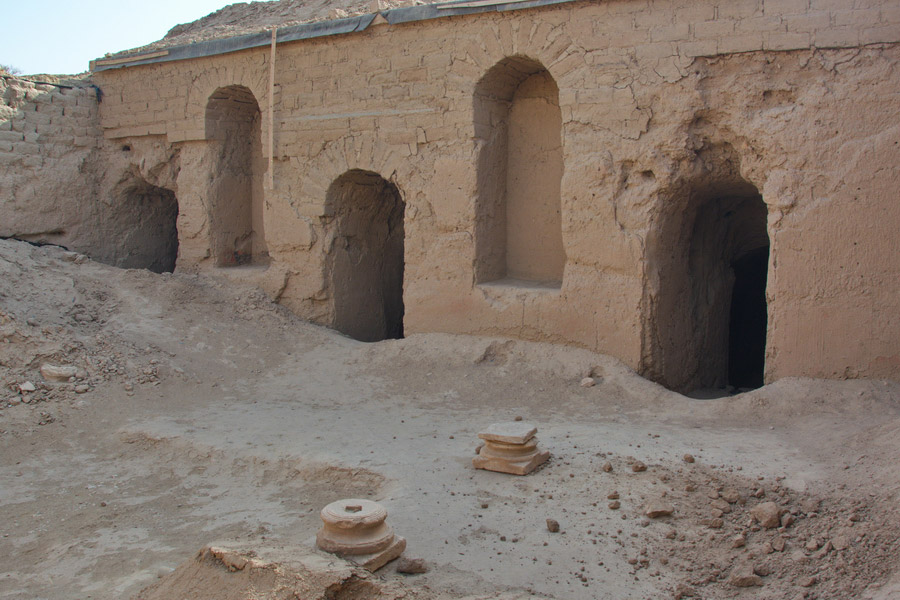
Buddhist Temple Karatepa
In 1928, the historian and art historian A.S. Strelkov discovered several caves in the slope of the sloping Karatepa Hill (in translation from the Uzbek “Black Hill”) near Termez on the Amudarya bank. The caves were filled with sand and debris of raw bricks. These bricks are large, square, from unbaked clay, used here long before the Arab conquest and not later than the 7th-8th centuries of our era. In the autumn of 1961 excavations under the direction of archaeologist B. Ya. Stavisky began on the hill of Karatepa. Before that, he had unearthed the cities buried in the loess hills near Samarkand, and secluded castles in the mountains of the Zeravshan Range, drove hundreds of kilometers in pursuit of the ghost of the Kushan culture, each stretch of this path steadily southward, to the banks of the Amu Darya, to Tarmita.
During the excavations at Karatepa, the entrances to the underground temples, littered with stone blocks and sand, were discovered. When analyzing the debris in the mountains of rubble and bricks, broken bas-reliefs came across, ceramic pottery, sometimes coins. It took three seasons to clear a few caves and a square yard. On its perimeter lay the stone bases of columns, round, on square bases. There was a smooth bright red plaster on the walls of the courtyard, a path on the floor of white limestone tiles and a high white stone threshold, on which, sixteen hundred years ago, someone painted with a black outline two unopened lotuses. A small hall opened behind the threshold. In the courtyard, archaeologists found fragments of statues, large, in human growth.
Long vaulted corridors, fragments of bowls, jugs, many lamps, oil-filled pots with a mashed spout for the wick all suggested the monastic life, the meager meal at the common table, the night prayers in the lamp-like semidarkness. On the lamps there was 1,500-year-old soot. As a result of the excavations of Stavisky, it was established that there were more than one temple or monastery on Karatepa, and the whole Buddhist complex was a system of temples. In addition, the finds on Karatepa declared their primordial Bactrian origin with such certainty, as if each were branded: “Made in Bactria.” Sculpture and colorful ornaments, the very architecture of Temmi temples all roots in the ancient local tradition. Bactrian art school as a whole, together with the renowned Gandhar school in India, participated in the creation of the art of early Buddhism, which left an indelible mark on the history of world culture.
This art has long dispensed with the image of the Buddha. His presence denoted symbols. For example, the wheel his first sermon, the beginning of the doctrine. The woman on the lotus and the elephant above her the birth of Buddha. The unsaddled horse symbolized the Great Departure, when the prince Gautama left his palace, his wife, his son and went to wander the Indian roads in search of truth. A particularly noteworthy finding made on Karatepa is a fragment of the wall painting “Buddha and monks”. The painting fell from the wall once, and clay, rubble, sand fell from above, but it did not scatter into a thousand pieces, but only cracked, lying under the weight of the dam, seventeen or eighteen centuries. On the mural, the image of the Buddha is an expression of abstract thoughtfulness, in the youthful ace, traditional distracted smile. But this is not a psychological portrait. This is not a face at all, but only a mask of higher understanding, to which, according to Buddhism, one should strive. The mask is just as conditional as the signs of the greatness of the Buddha a protrusion on the crown of the head, a third eye between the eyebrows, elongated lobes of the ears, and as symbolic as the blue background, a white halo around his head, a white halo covering the entire figure. Thus the canonical image of the Buddha was created, and so gradually the memory of the wandering philosopher, brave wise man, who said: “Poor, rich and noble everyone is equal”.
Buddhist art is a vast artistic world, vast in number of works, multisyllabic in composition and origin. All the more striking is the idea that art developed in the Kushan culture was part of it. The fate of Buddhism is intertwined with the fate of the Kushan state.