
 3, Pushkin str., Samarkand 140100 Uzbekistan
  +998 90 655 05 00
  info@sacredeasttravel.com


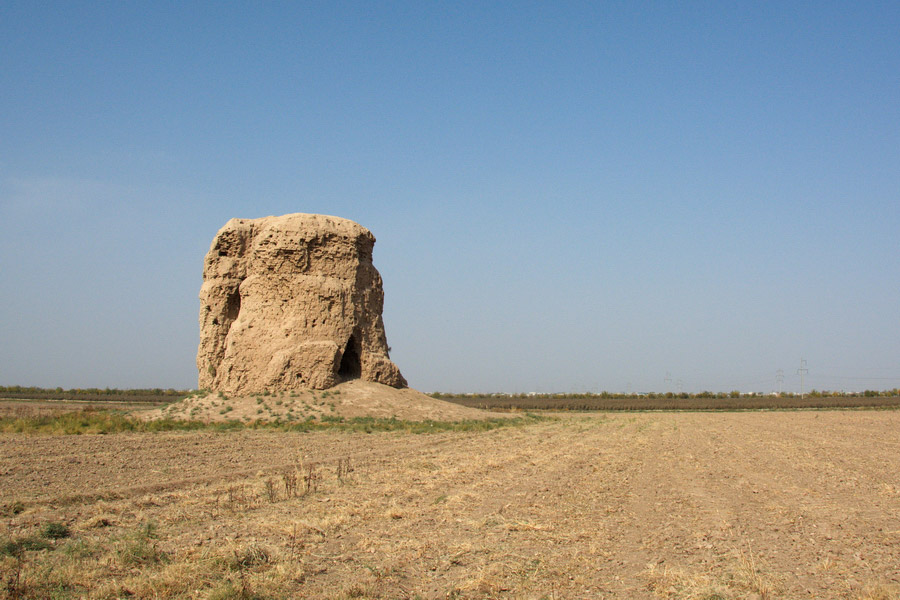
Buddhist stupa Zurmala
To the south-east of the ancient settlement of Old Termez, on the side of the road leading to modern Termez, there are the remains of a structure known as the Zurmala Tower. The ruins of the tower have long attracted the attention of archaeologists. Back in 1926, they suggested that it was nothing but a Buddhist stupa. A detailed survey, conducted half a century later, confirmed that this is a cult structure that belongs to the era of the heyday of the Kushan kingdom. The tower was badly damaged by the time, however, it makes an impressive impression. It is laid out of raw square brick. All bricks have a characteristic brand in the form of a feature and two pits. Such bricks were used in Bactria only in the Kushan time, that is, at the beginning of the III century. n. e. Scientists estimated that it took almost 1,200,000 such bricks to erect a stupa. A solid block of raw brick has in the upper part a small chamber for relics – a reliquary.
The cylindrical body of a stupa 14.5 meters in diameter rises 13 meters above the base. Stupa is one of the most important and ancient Buddhist symbols. The oldest stupas, and the stupa Zurmala, also belong to them, represented a hemisphere composed of bricks and stones. By the way, the very word “stupa” in Sanskrit literally means “a lot of land or stones”. Another important purpose of the stupa is repository of Buddhist relics. In the first centuries after the death of the Buddha, a box of cubic form, the so-called “house of God,” was laid with a strand of hair from the head of the Buddha, a cloth flap from his clothes, a particle of his incorrupt relics. Later, as precious relics were stored precious metals and stones, grains – symbols of God and divine power. The reliquary was placed on the top of the stupa. As you know, Siddhartha Gautama, the founder of the teachings, received the name Buddha “Enlightened”, was the son of a prince of northeastern India. And since the Buddha was perceived by believers not only as a spiritual mentor, but also as the king of the gods and the universe, then several umbrellas were placed on the stupa in honor of the supreme authority of the Teacher.
The rod and umbrellas on the stupa, of course, did not survive, but the wall drawings from the cave Buddhist temple of Karatepa, located nearby, on the ancient settlement of Old Termez, allow us to judge the design of the Bactrian stupas. As a rule, it is a stepped three-tiered tower with a dome completion, on the top of which a rod with “umbrellas of honor” is erected. Based on an analysis of stupa proportions, archaeologists came to the conclusion that the original appearance of the Zurmaly tower was close to these images.