
 3, Pushkin str., Samarkand 140100 Uzbekistan
  +998 90 655 05 00
  info@sacredeasttravel.com


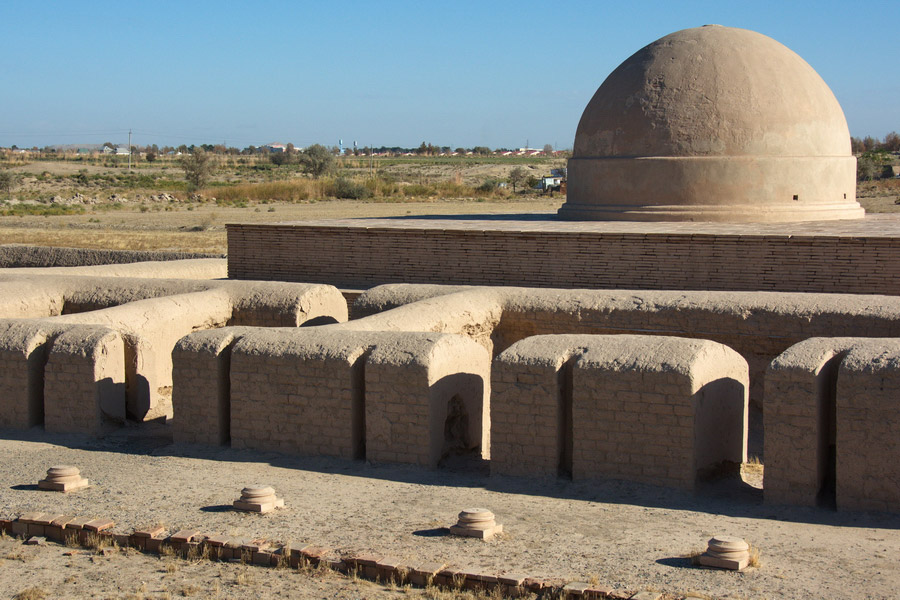
Buddhist temple Fayaz -Tepa
The Buddhist complex of Fayaztep was first discovered and explored by the archaeologist L. Albaum. The modern name of the monument was formed from the name of the director of the Surkhandarya Regional Museum of Local History R.F. Fayazov, who provided great assistance to archaeologists in 1968, when excavations began here. This monument is located not far from the ancient settlement of Tarmita. The complex covers an area of 117×34 m. It is located between the Amu Darya River and the ancient caravan road.
This grandiose structure is clearly divided into three parts: a temple, a monastery and outbuildings with a refectory. Each of them consists of a courtyard and the premises around it. Apart from the main part, a stupa with an ideally round dome is erected on a special pedestal. It refers to the I century BCE and is considered the oldest structure of the complex inside which is hidden symmetrical to it, but smaller in size -only 2.8 meters in diameter. The central part of the complex consists of a courtyard, on the perimeter of which there are rooms, and an adjacent aivan. The walls of the aivan gallery, resting on a number of columns, are decorated from the bottom to the top with colored images. According to the assumption of archaeologists, there was a temple here. The north-western part of the complex is a complex monastic layout. In his small courtyard were located a one-sided closed aivan and cells of monks. Also, according to irrigation, there was a water pipeline to Fayaztepa – the water was fed to the temple along an aqueduct 2.5 km long. The second half of the 1st century is considered to be the time of the monastery construction. Excellent Buddhist sculptures, found during excavations, depicting the Buddha, Bodhisattva and the characters of the upper Kushan state, enriched the treasury of monuments of the ancient culture of Uzbekistan. It was here that archaeologists discovered a beautiful statue of Buddha with two monks -the famous “Triad”, now adorns the exposition of the Museum of History of Uzbekistan in Tashkent.
The final stage of the great archaeological work carried out in the temple and monastery complex of Fayaztepa for forty years was the opening here of a scientific center for its study. In recent years, the joint Uzbek-Japanese expedition under the direction of E. Rtveladze and Kiyudzo Kato has worked and worked fruitfully on the complex. Given its important historical significance for the study of the Buddhist era, the Ministry of Culture and Sports of the Republic of Uzbekistan, UNESCO, the Trust Foundation from Japan awarded a grant for the restoration and conservation of the facility. And after the restoration work carried out during 2004-2006, the Fayaztep complex became an open-air museum.