
 3, Pushkin str., Samarkand 140100 Uzbekistan
  +998 90 655 05 00
  info@sacredeasttravel.com


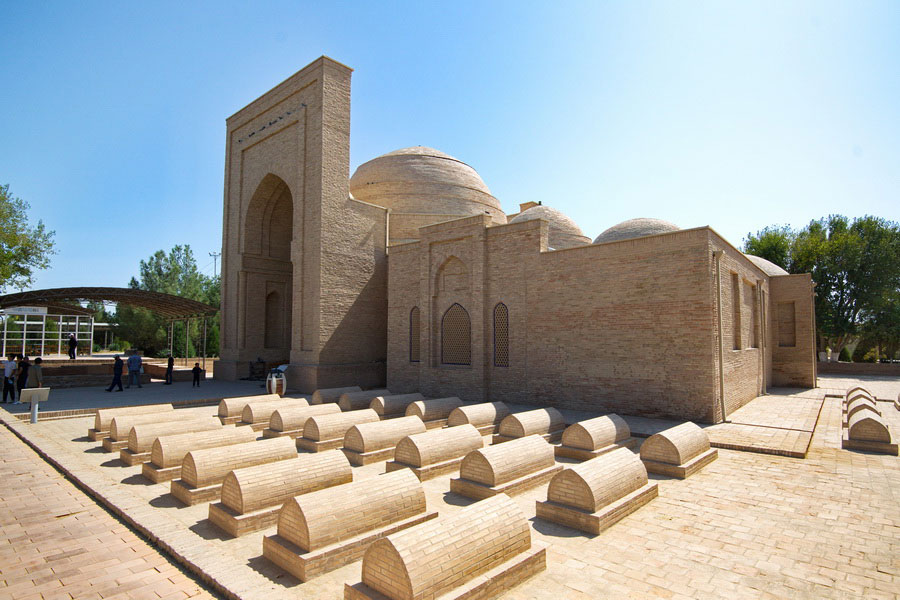
Al Hakim At-Termizi Mausoleum
The architectural complex of Hakim at-Termizi was built in honor of the famous spiritual figure and Sufi Hakim at-Termizi, who was the founder of the Sufi order “Hakimi”. The complex was erected on the site of a Buddhist temple in the IX century. From the first building only the courtyard, fenced with raw walls, has been preserved. After the death of the Sufi, his burial is kept outside the khanaka, where a mausoleum with kari-hana was later built.
Judging by the legend, the son of at-Hakim – Abdallah rests in this mausoleum. During the reign of Khalil-Sultan in the beginning of the XV century, a large khanaka was built for rituals. Khanaka was erected in the best traditions of the dynasty of the Temurids and compared to the modest dwellings, favorably stood out against the general background. It is worth to cancel the tomb of Hakim at-Termizi, made of white marble and decorated with ornamental patterns. The side of the gravestone faces the mosque and is considered a mikhrab. In the center of the gravestone is a niche, along which the lamps are located. To date, the writings of Hakim at-Termezi are of great interest not only to fans of Sufism, but also as works of philosophy in the field of Islamic studies. Hakim al- Termizi wrote many significant treatises after performing the hajj in Mecca. He wrote more than 30 books, where he re-wrote the meanings of many of the Koranic dogmas, among them the most famous is the “Great Assembly.” In this book, he expounded 408 hadiths about the personal life of the Prophet Muhammad.
Being already in his old age Hakim at-Termizi returned to Termez, where he settled near the ruins of a Buddhist temple. It was at this place that the Hakim at-Termizi complex was built in the 9th century. The modest way of life of the Sufi and his philosophical works still cause genuine interest among Sufi fans. The architectural complex of Hakim at-Termizi is one of the popular places for pilgrimage. In 1990 Termez celebrated the 1000th anniversary of Hakim at-Termizi on the initiative of UNESCO.