
 3, Pushkin str., Samarkand 140100 Uzbekistan
  +998 90 655 05 00
  info@sacredeasttravel.com


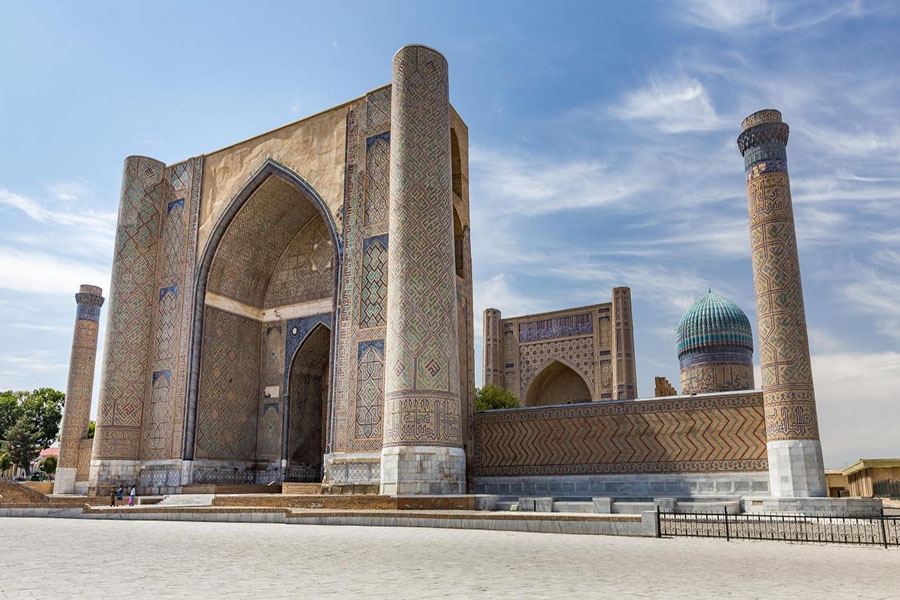
Mosquée Bibi-Khanym
Les majestueuses coupoles bleues de la mosquée Bibi-Khanym sont un spectacle inhabituel qui prend son souffle même à la compréhension de l'échelle de construction de ce monument, impressionnant par sa taille et sa beauté. Dans l'antiquité, le dôme de cette mosquée était comparé au dôme du ciel et à l'arc du portail - à la Voie lactée. En plus de tous les monuments de Samarkand, la mosquée Bibi Khanym a également la belle légende. Selon lui, le redoutable dirigeant a construit la mosquée en l'honneur de son épouse préférée Bibi Khanym. Après une campagne réussie en Inde, Temur a décidé de construire le plus grand bâtiment de l'Est - la mosquée - qui aurait dû dépasser toutes les mosquées du monde par sa taille. Murs étincelants, hauts minarets, large portail de la mosquée, décoré de marbre sculpté, ont dû louer pendant des siècles le nom de Temur et de sa femme préférée.
Des centaines d'architectes, de peintres et de constructeurs ont été emmenés à Samarkand. La construction a duré 5 ans (1399-1404) et lorsque Temur est revenu d'une autre campagne, il était prêt à l'emploi. La cour de la mosquée était entourée de galeries luxueuses, dont les arcs reposaient sur plus de trois cents colonnes de marbre, des minarets en dominaient de chaque côté. Malheureusement, peu de temps après l'achèvement de la construction, lorsque la mosquée est devenue le lieu des cérémonies de culte, le bâtiment a commencé à s'effondrer. L'idée du créateur de construire un bâtiment aussi magnifique était trop audacieuse pour cette période. L'arc majestueux du portail, qui selon le plan de Tamerlan aurait dû répéter la Voie lactée, n'a pas pu résister à l'épreuve du temps et s'est effondré dans les toutes premières années après la construction.
But thanks to the painstaking work of historians, archaeologists and art historians, we have the opportunity to present the original appearance of Bibi Khanum. The finest geometric, vegetative and epigraphic ornaments, as well as majolica combined with inorganic bricks and carved mosaic decorate the building of the mosque. On the inside of the dome were gilded papier-mache products, and on the walls – ornamental painting on plaster. Small mosques have a more modest decor – this was done intentionally, to better emphasize the importance of the main building.
In 1968, work began on the restoration of the complex Bibi Khanum, but the residents and guests of Samarkand could see almost completely the restored structure only by the beginning of the 2003 tourist season. Again, the arch of the main portal, which was destroyed about half its height, was rebuilt. The lower marble frame remained original, and the old veneer is immediately visible – it is darker. Just like on the main mosque, the original ornament is darker than the modern reconstruction, which is 90%. The partially preserved north-western minaret was completely lined, and three other minarets were rebuilt, rebuilding and lining. At the same time, the height of newly built minarets is less than that of those built by craftsmen in the 15th century. The dome of the main mosque and the dome of the side mosques were also completely restored. Today, the reconstruction work in Bibi Khanum continues, across the street from the mosque, there is an original monument – an octagonal pillar-shaped mausoleum by Bibi khanum with a crypt. This building has no main facade, and judging by the tiled and painted decor, the mausoleum was attached to the Bibi Khanum mosque. The frame of the mausoleum testifies that it was erected at the same time as the mosque. Marble sarcophagi are placed in a spacious vault on the floor. When in 1941 the sarcophagi were opened, they found the remains of two richly dressed middle-aged women. It is possible that one of them was Sarai Mulk Hanum, she is Bibi Khanum.
Separately I would like to note the bazaar, which is located near the Bibi Khanum mosque. After 900 years, he did not lose his colour and still continues to live his unique life of the oriental bazaar.