
 3, Pushkin str., Samarkand 140100 Uzbekistan
  +998 90 655 05 00
  info@sacredeasttravel.com


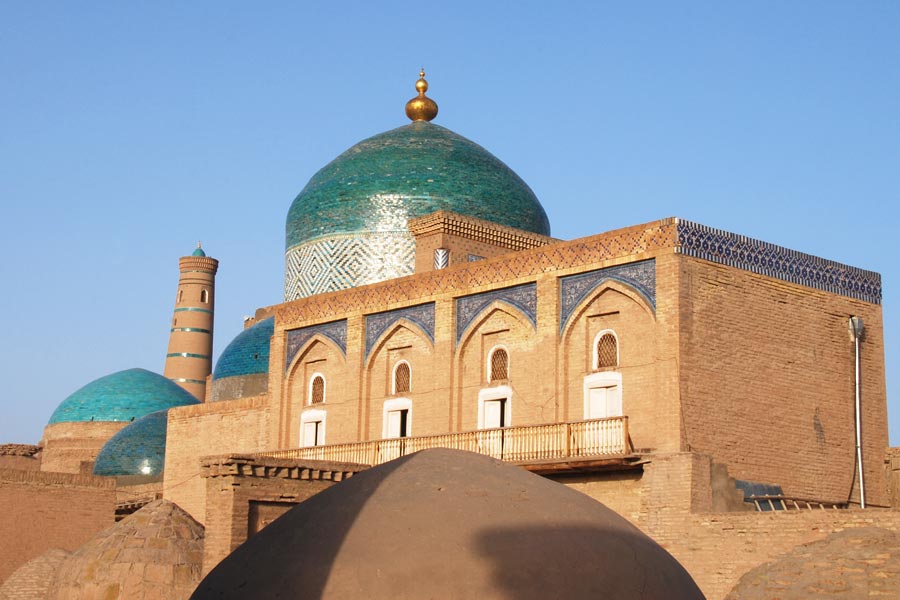
Сomplex of Pahlavan Mahmud
The complex of the Pahlavan Mahmud mausoleum was built only in 1701, as evidenced by the engraving on the stone gates. The dome of the mausoleum is covered with blue glazed tiles with a sparkling gilded top. Originally the mausoleum was a modest and small, but it quickly became a place of pilgrimage with a great number of hujras, khanaka and mosques. The walls of the mausoleum are decorated with magnificent majolica. In 1810, after the successful campaign of Muhammad Rakhimkhan to Kungrad, a radical reconstruction of the mausoleum, which was included in the side gallery of the new building, the main hall, began. The construction of 1810 was supervised by the master Adina Muhammad Murad of Hazorap; majolica, dated 1825, was made by Mullah Nurmukhammad, son of UstoQalandarKhivaki and Sufi Muhammad, son of master Abduljabbar. In addition to the burial of Pahlavan Mahmud, the mausoleum contains the graves of Muhammad Rahimkhan I, Abdulgazikhan and Elbarsa II. Members of the Khan’s family are buried in the Annex of the early twentieth century. Thus, the mausoleum of Pahlavan Mahmud became the tomb of Khiva khans. The memorial complex also includes a madrassah and a summer mosque. At the beginning of the XX century, a two-story structure was erected in front of the tomb, one of the rooms of which was given over to the richly decorated tomb of Isfandiyar Khan.