
 3, Pushkin str., Samarkand 140100 Uzbekistan
  +998 90 655 05 00
  info@sacredeasttravel.com


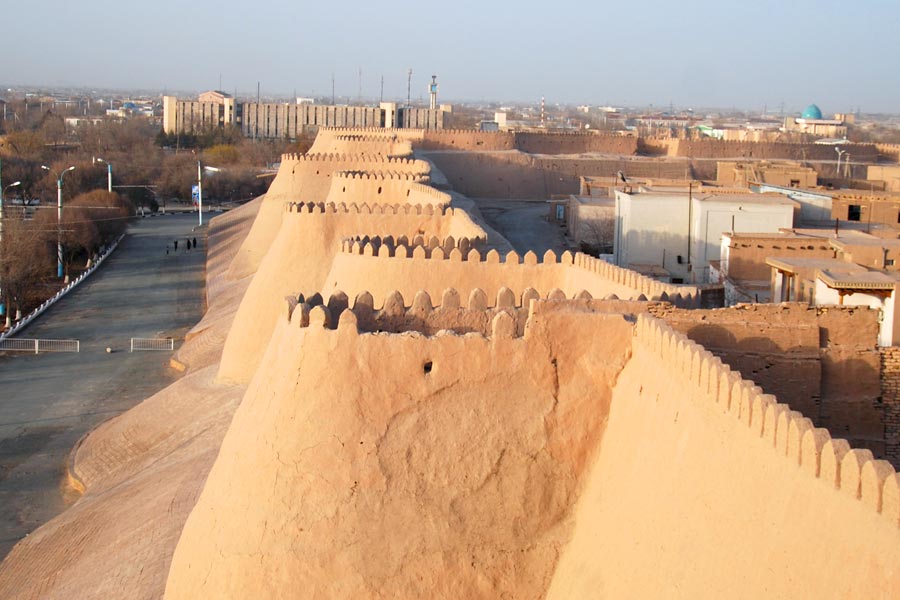
Ichan-Kala
Ichan-Kala is the densest part of Khiva, but is home to the architectural museum, where we can see the best works of national masters. Especially dense are the buildings area of Ichan-Kala, which is situated along the road, passing from the western to eastern gates. The buildings here are situated without any architectural planning. Some groups of buildings formatting constructional estates, where separate buildings interflowing with each other by there sizes. Only the wide arch spans or portals determine the separate buildings. High walls, light angled towers, cupolas, minarets, and light ayvans with wooden columns are everywhere creating unexpected silhouettes.
Town walls are rare samples of medieval fortification, preserved up to present day. Khiva town was surrounded with two rows of walls Ichan-Kala (inner town) and Dishan-Kala (outer town). The wall of Ichan-Kala were embanked in between the 5th and 6th centuries BC, they are higher then the level of Dishan-Kala, probably because of natural relief (according to the legend, the town was built on a sandy hill). The town walls were built of adobe and were rebuilt several times during the centuries. The wall of Ichan-Kala is 8-10 meters high, 6-8 meters in width, and 2,250 meters long. After each 30 meters there are round defensive towers, sticking out the boundaries of Ichan-Kala wall. There are toothed railing with narrow embrasure above the wall and towers, for repulsing the enemies attacks during a siege. In the system of defending fortification there were ditches, filled with water; even today, by relief, this can be seen in the southern part, in northern and western parts asphalt covers the ditches.
The town gates were also a part of the fortification system. They have the special devices, which were used by the towns protecting guards. On both sides of the arch passage, there are “blowing” towers, above the gate there is an inspection gallery. The passage is covered by an arched roof (Koy-Darvaza), or if the passage is too long, by several cupolas. On the sides of the passage, there are domical rooms, where sentries and customs officials lived, there also were a room for a court, and sometimes a room for a prison. In the eastern towns and cities, the gates and entries to the public and private places have a special meaning: the more impressive they are the more honor and acknowledgment the town has.
In the course of time, the defending function of the gates lost there importance, and the gates became the part of the towns design. The gates were trimmed with beautiful and multicolored glazed tiles and ayats from the Koran. Sometimes on the gates were written the text, for instance praise for khan, or a fragment from the poem. Some gates, as the time passed, were made over the shops. The walls of Ichan-Kala have 4 gates: Ata-Darvaza, Palvan-Darvaza, Tash-Darvaza, and Bagcha-Darvaza. The walls of Dishan- Kala had 10 gates, but presently there are only 3 gates preserved.