
 3, Pushkin str., Samarkand 140100 Uzbekistan
  +998 90 655 05 00
  info@sacredeasttravel.com


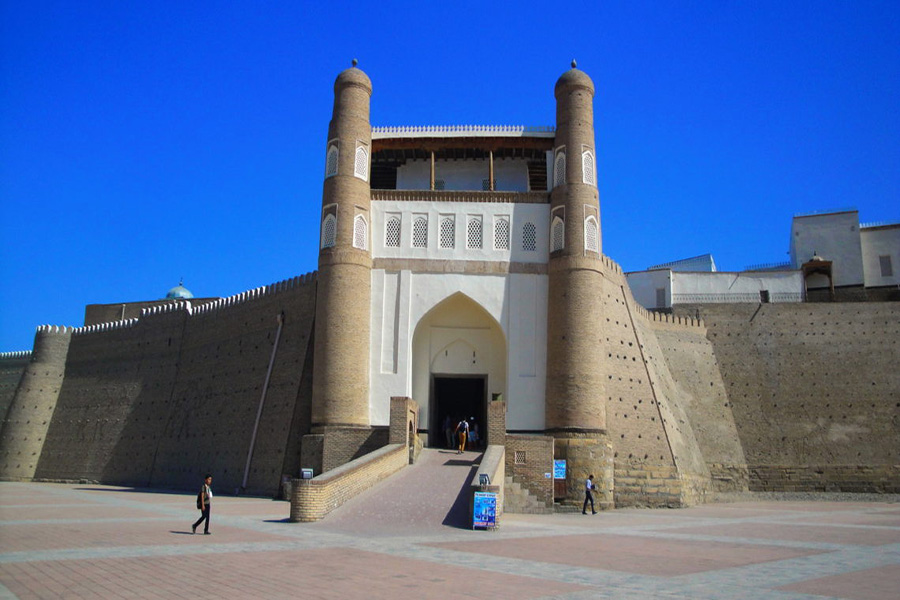
Ark Citadel
Bukhara Ark is an ancient citadel in Bukhara the stronghold of the last emirs. At one time the Ark, towering over Registan Square, was a symbol of greatness, power and inaccessibility. On one of the walls of the Ark there was once a large leather whip (Kamcha) – a symbol of power in the Bukhara Emirate. At the beginning of the XX century in the Ark lived about three thousand people. In the fortress were located: the palace of the rulers, the palace services of bureaucratic aristocracy and military leaders, craft workshops, treasury, arsenal, dwellings of relatives and dignitaries of the courtyard, warehouses of clothes, carpets, weapons and palace treasures. Fortress Ark is the oldest architectural and archaeological monument of Bukhara. Arch is a large earthen fortification in the northwestern part of modern Bukhara. In terms of it, it looks like an irregular rectangle, slightly stretched from west to east. The perimeter of the outer walls of the Arch is 789.60 m, the inner area is 3.96 hectares. The height of the Registan square rises from 16 to 20 meters.
All the remaining buildings belong to the periods of the rule of the Uzbek dynasties of Ashtarkhanids (XVII century) and Mangyt (XVIII-XX centuries). The main entrance to the citadel is architecturally framed by two towers. At the top of the tower are connected by a gallery with a well-preserved room and terraces for the city guard. The ascent to the main gate is a ramp that leads through an indoor long corridor to the cathedral mosque of Jome. Along the corridor there are rooms for water (obhana), sand (reghan) and a chamber (kanakhana) for prisoners. In the western part there is preserved: the throne room – “khunishish-khona” (XVII century), the cathedral mosque Jome (XVIII century), the courtyard of the prime minister of the emir “kushbegi-bolo” (XIX-XX century), the court of greetings “salom khona “(XIX-XX century.), And the stable yard” sais-khona “(XIX-XX century.). In the southern part preserved: the mosque Honako (XIX century.) And the remains of the bath of the emir (XIX century.). In the northern part – Honako Battol-Gozi (XVIII century.) And the mosque “Childukhtaron” (40 girls), built in the XVIII century. in memory of the forty girls who died on the orders of Emir Nasrullah. The eastern part was not preserved, it was destroyed in 1920 by Sovits in bambardment, now it is an archaeological reserve.