
 3, Pushkin str., Samarkand 140100 Uzbekistan
  +998 90 655 05 00
  info@sacredeasttravel.com


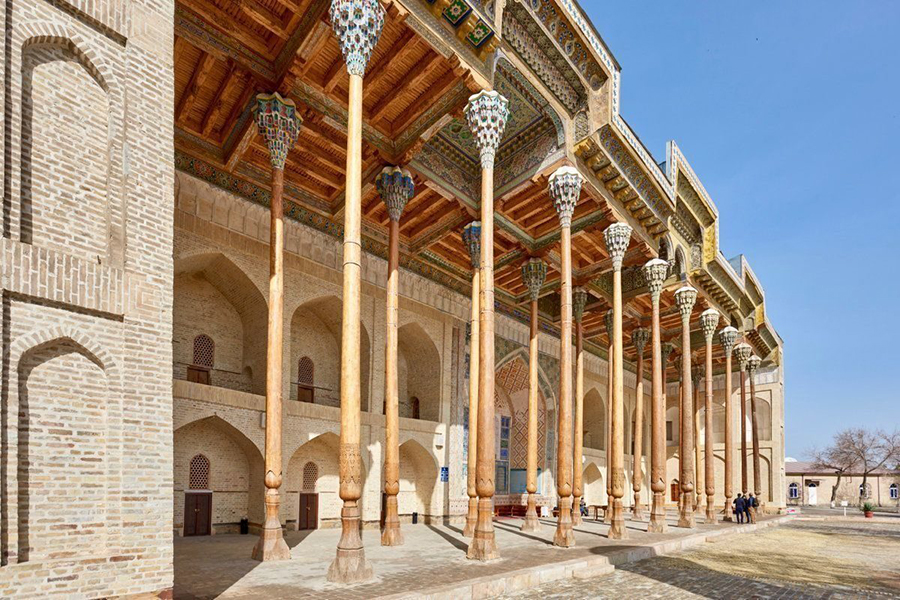
Bolo-Khauz Complex
Complex located in Registan Square, which consists of a mosque, a minaret and a house, was built in 1712, also known as the Forty Column Mosque. Until 1917, Bolo-House was built as a mosque of the Emir, but later it became a common Friday mosque, where still the faithful at noon prayers. According to legend, the mosque was built in honor of the mother of the Bukharian ruler of Abu Fayud Khan, another version says that it was originally built by the emir of Shah-Murad, as a general mosque.
The mosque was built in the style of the XIX-XX centuries. At the beginning of the XXth century, an open aivan was added to the mosque, which is a real work of Uzbek national decorative art. Wooden columns, installed in two rows, are the backbone for aivan. The magnificent painting, decorating loggias with arched overlapping and a ceiling of aivan strikes with its beauty. In 1917, in front of the mosque, near the pool, was built a small minaret, whose walls are decorated with patterned brickwork, the hallmark of this mosque is its miniature and proportionality. Bolo-House is divided into winter and summer mosques. The Winter Mosque is a four-chamber hall with several entrances. The summer mosque is aivan, which surrounds the winter hall of the mosque on three sides.
Despite the fact that the Bolo-Mosque Mosque was built relatively later than other architectural monuments, it can rightly be considered one of the most beautiful and magnificent sights in Bukhara.