
 3, Pushkin str., Samarkand 140100 Uzbekistan
  +998 90 655 05 00
  info@sacredeasttravel.com


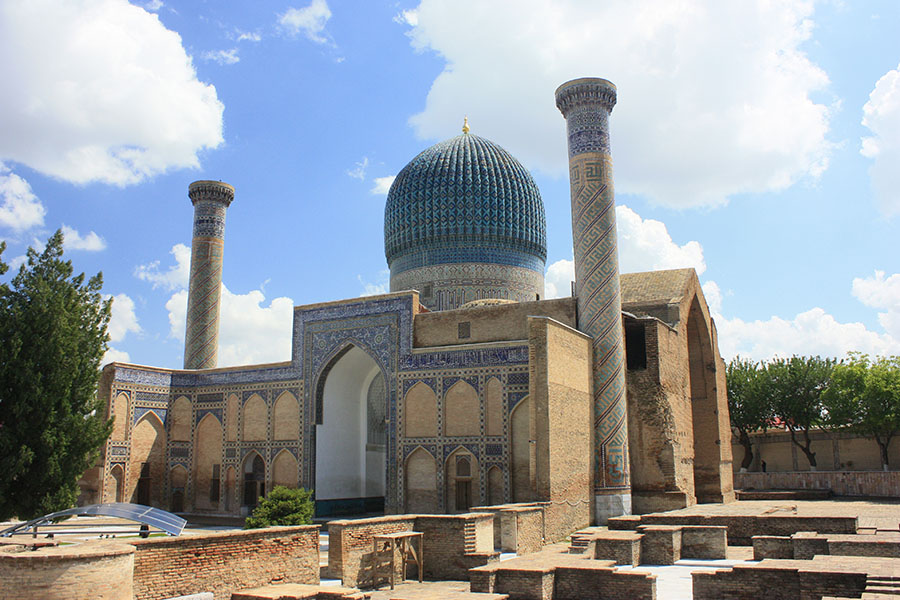
Gur Emir Mausoleum
“The Tomb of the Emir” is the mausoleum of Tamerlane (Amir Timur) and his family (Timurids) in Samarkand. The family tomb of Timur and the heirs of the empire was erected in the south-western part of the city in 1403. The mosaic, assembled from light and dark blue glazed bricks, decorates the walls and the drum, the geometric mosaic ornament brightly shines in the sun. This masterpiece of Central Asian architecture occupies an important place in the history of world Islamic architecture. The tomb of the Timurids (it was so since 2009) served as a prototype for the famous monuments of the Mughal era architecture: the Humayun mausoleum in Delhi and the Taj Mahal mausoleum in Agra, built by the descendants of Timur, who at one time were the ruling dynasty of Northern India. The monument was restored in the 1950s (outer domes and icing), more extensive works on its restoration were started in 1967. In 2014, by the decision of the Inter parliamentary Assembly of the CIS Member States, the list of attractions of the “Pearls of the Commonwealth”. The construction of the mausoleum, begun in 1403, was associated with the sudden death of Muhammad Sultan, the direct heir of the Emir Timur (Tamerlane) and his beloved grandson. Completed the construction of Ulugbek, another grandson of Tamerlane. During the reign of Timur, the mausoleum became the family crypt of the Timurids. In this architectural ensemble are the graves of Timur himself, his sons Shahrukh and Miran Shah, as well as grandsons – Ulugbek and Muhammad Sultan and Timurids Abdullo Mirzo, Abdurahmon Mirzo, teacher and mentor of Timur Mir Said Baraka. On an elevation of a tomb behind a marble fence there is an unknown tombstone of a certain Sufi Sayid Umar. According to T. Saidkulov, this could be sheikh Kulal. In the mausoleum, the son of Abu Said Timurid was also buried and the grandson of the head of the Uzbek ulus of Abulkhayrkhan from the daughter of Khan-hade begim – Sultan Muhammad.
The mausoleum was built in the south-eastern part of medieval Samarkand, erected at the end of the XIV century by the order of Muhammad Sultan. From the composition of the buildings of the ensemble of Muhammad Sultan it follows that he planned the construction of the center of Islamic education, and not the funeral complex. However, later the will of his powerful grandfather gave another meaning to the ensemble, whose center was precisely the mausoleum. By the beginning of the 20th century, only the foundations of the madrassah and khanaka, the portal of the main entrance and part of one of the four minarets have been preserved. During the reign of Ulugbek a doorway was made to provide access to the mausoleum. Near the grave of Timur were placed marble tombstones of his sons Miran Shah and Shahrukh and his grandsons Muhammad Sultan and Ulugbek. At the same time, a legendary jade plate containing an epitaph appeared on the grave of Tamerlane. In 1871, the military engineer ZE Zizhemsky led the road to the mausoleum of Gur-Emir, which connected this monument with the fortress and began to be built at that time a new city.
In 1941, graves in the crypt were uncovered by the anthropologist Gerasimov, and historical information about the appearance of Timur, about the violent death of Ulugbek, about the authenticity of burial places of other Timurids was confirmed.
In 1916, the vault over the crypt was rebuilt and the stone floors were redone.
In the 1950s, the outer domes and icing were restored.
In 1967, large-scale works were begun to restore the complex.
In 1996, by the 660th anniversary of Tamerlane, two minarets were reconstructed from photographs and dimensional drawings made in the 19th century.
Outwardly Gur-Amir is a single-domed building with a crypt. It stands out for its simplicity and solemn monumental architecture. The huge ribbed dome dominates (the diameter of the dome is 15 meters, height 12.5 meters), slightly overhanging the cylindrical drum. The lower part of the building represents an octahedron, which is almost hidden by many later additions. To the north is a small portal. The dome and the drum account for more than half of the total height of the building. The dome is covered with a pattern of blue and blue tiles, which also distinguishes its ribbed form. On the drum there are inscriptions containing praises to Allah. The walls of the octahedron are also decorated with white and turquoise tiles on the background of unglazed brick. Inside at the bottom, the walls are decorated with a marble panel with inserts of green serpentine and friezes of carved inscriptions, and above are painted with blue paint and gold. Relief rosettes on the plafond of the dome imitate the starry sky. Decorative decoration complements openwork grilles on the windows and a marble fence around the tombstones, but they are only a decoration, the real ones are in the basement. In the first years after the death of Amir Timur, the mausoleum was richly decorated with weapons and utensils.