
 3, Pushkin str., Samarkand 140100 Uzbekistan
  +998 90 655 05 00
  info@sacredeasttravel.com


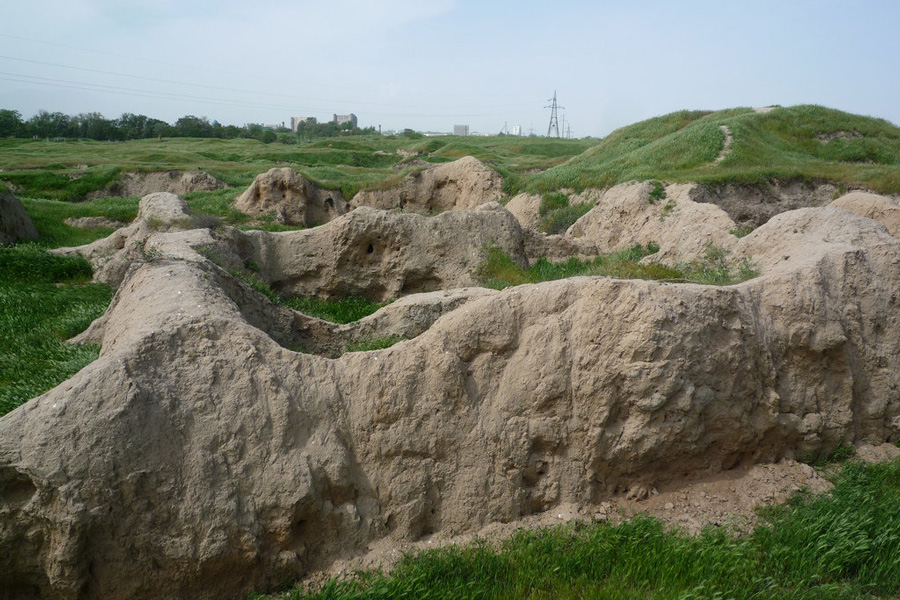
Settlement of Afrasiab
Scientists attribute the beginning of Samarkand to the VIII – VII centuries BC. It was at this time on the northern outskirts of modern Samarkand, the ancient site Afrosiab. The area of the ancient settlement is more than 200 hectares. From the north and east it was protected by cliffs of river channels, from the south and west by deep ravines. It is believed that Afrasiab was the ancient Sogdian capital – the famous Marakanda. The ancient city got its name – Afrosiab in honor of the legendary king of Turan and one of the heroes of the poem of the great Persian poet Firdausi “Shahname”. During the reign of the Persian Empire of the Achaemenids (VI century BC), the city was surrounded by a high massive wall with internal corridors and towers. The Persian Empire in IV in BC. fell under the onslaught of the army of Alexander the Great. In 329 BC. the Greek phalanx entered Maracanda. The campaign of Macedon to the East was delayed for several years by the uprising of the Sogdians led by Spitamen, during the suppression of which, Alexander destroyed Marakanda. The revival of Sogdiana occurred under the Seleucids. Now Afrosiab is a huge cluster of lifeless hills. But in the distant past life was boiling here, markets were rustling, craftsmen worked. It is this that explains the close interest of scientists to the site of Afrosiab.
Archaeological research in Afrasiab began in the late 19th century. Archaeological research confirmed that several centuries before the beginning of our era Samarkand was one of the largest shopping and cultural centers of Central Asia. Samples of clay ornamented dishes, terracotta figurines, fragments of ossuaries, glassware, various tools, women’s jewelry, coins were found at the site. It was found that the city was intersected by straight paved streets and divided into blocks – Guzary, was surrounded by powerful defensive walls, inside of which there was a citadel – Shahristan, temples, apartment houses and craft workshops. For example, in the opened buildings dating from the 6th and 7th centuries, the walls were decorated with a highly artistic painting executed by bright glue paints on clay plaster. In one of the premises were found original genre paintings, which are located on the walls in three tiers. They depicted the procession of men and women in festive elegant costumes, accompanied by real and fantastic animals, bearing rich gifts. On the walls of the palace of the ruler of the city was found a large composition depicting a procession, led by a figure on a white elephant, which, apparently, portrayed a princess or a queen. Apparently, this is portrayed a wedding procession, and on the elephant to her groom, the princess is sent to the palace accompanied by her friends and important dignitaries.
Also on Afrosiab was found a large hall, decorated with wooden sculptures, charred from a fire that destroyed the city thirteen centuries ago. During the excavations, bas-reliefs of a landscape character were also found. In the 9th-10th centuries, when Samarkand became one of the cultural centers of the Islamic East and the first capital of the Samanid dynasty, a magnificent royal palace was built in the western part of Afrasiab. By the 10th century, the inner part of the city had reached 220 hectares. To the south of it was located a suburb with bazaars, mosques, baths and caravanserais. A water pipe from lead pipes “Arsis” was built in the city and paper production was arranged. In the 11th-13th centuries Samarkand became the capital of the Karakhanid state and was surrounded by new defensive walls. In the citadel the palace of the Karakhanids was erected. At the beginning of the 13th century Khorezmshah Muhammad seized Samarkand and built a new palace on the site of the Karakhanid palace. In the 13th century, the state of Khorezmshah was conquered by Genghis Khan, Samarkand was captured by the Mongols. During the internecine wars of the second half of the 13th century, Samarkand suffered greatly, and this led to the complete desolation of the ancient settlement on Afrasiab. Later, Samarkand already developed on the site of the former “rabad” – the urban suburb.
The Museum of the history of the city, located on the site of the ancient settlement Afrosiab, contains exhibits from different periods of the ancient history of Samarkand – ossuaries, remains of ancient blades, knives, arrows, coins, ceramics, and unique frescos discovered during excavations on the site.
After visiting the Museum, you can also wander through Afrosiab, from the height of the hills admire the panorama of the old city, its blue domes and minarets. Here, to the sound of the winds and the rustle of the grass, your thoughts will pass unnoticed into the past …