
 3, Pushkin str., Samarkand 140100 Uzbekistan
  +998 90 655 05 00
  info@sacredeasttravel.com


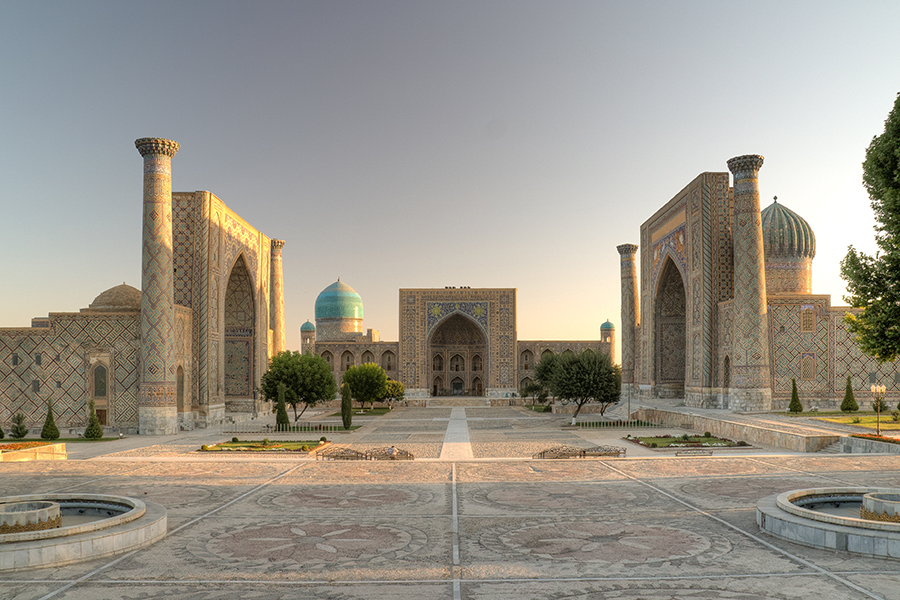
Registan Square
Combination of two words reg – sand and stan – place; literally – a place covered with sand an area in the center of Samarkand. “Registan” was called the main square in the cities of the Middle East. Samarkand Square is the most famous thanks to the famous architectural ensemble of the XV-XVII centuries located on it, the center of which is the Madrassah of Ulugbek (1417-1420), the Sherdor Madrassah (1619-1636) and the Madrassah Tilla-Kari (1646-1660). The ensemble of three madrassahs is a unique example of the art of urban planning and a wonderful example of the architectural design of the main square of the city. It is one of the brightest examples of Persian architecture. In 2001, this ensemble, together with other ancient historical buildings of Samarkand, was inscribed on the UNESCO World Heritage List.
Ulugbek madrassah is the oldest madrassah in Registan Square and was erected in 1417-1420. the ruler of the Timurid state and the scientist-astronomer Ulugbek. The erection of this structure, and a little later the observatory, brought Samarkand the fame of one of the main centers of science of the medieval East. Madrassah was built in the western part of Registan Square, opposite to it a few years later was built the khanaka of Ulugbek, and the northern side was occupied by caravan-sarai. The last two buildings stood for about two centuries, and then in their place in the beginning of the XVII century appeared surviving to the Sherdor madrassa and the Till-Kari madrassah.
Rectangular in terms of madrassah had four aivans and a square courtyard, along the perimeter of which were located deep niches, leading to two-tiered cells, where students lived. The back side of the courtyard was occupied by a mosque, four domes towered above the corner educational auditoriums of the madrasah, and four minarets were located at the corners of the building. The building is facing the square with a majestic eastern portal with a high pointed arch, above which there is a mosaic panel with geometric ornamentation, made of colored bricks, irrigated and carved ceramics. Madrassah Ulugbek was one of the best spiritual universities of the Muslim East of the XV century.There studied the famous poet, scholar and philosopher Abdurakhman Jami. Lectures on mathematics, geometry, logic, natural sciences and theology were read at the educational institution and were read by their famous scientists of that time: Kazi-zade ar-Rumi, Jemshid Giyas al-Din Al-Kashi, Al- Kuschi, and also Ulugbek himself.
Madrassah Sherdor was built on the site of the Khanaka of Ulugbek, which arose in 1424 in the eastern part of the square opposite the Madrassah of Ulugbek. By the beginning of the XVII century, the khanaka along with other buildings of the square had decayed and deteriorated. By the order of the Uzbek ruler of Samarkand Yalangtush Bahadur, construction of the Sherdor and Tillya-Kari madrassas was started. Madrasah Sherdor (madrassah “with tigers”, “Abode of lions”) was erected by an architect named Abdul-Jabbar, decorator Muhammad Abbas.
Sherdor madrassah is almost repeats the opposite Ulugbek madrassah, although in distorted proportions. It is distinguished by an inordinately large dome, which could cause the gradual destruction of the building already a few decades after its construction. The walls of the madrassah are covered with quotations from the Koran, the emblem of Samarkand is depicted on the entrance portal – leopards with the sun on their backs, a swastika is placed in the center of the arch, and “God Almighty” is written on top of the special Arabic script. The decoration of the external and internal facades is made of glazed brick, mosaic sets and paintings with an abundance of gilding. Finishing of the Sherdor madrassa is noticeably inferior to the refinement of the madrasah of Ulugbek, erected in the 15th century, which was the “golden age” of the architecture of Samarkand. Nevertheless, the harmony of large and small forms, elegant mosaic pattern, monumentality, clarity of symmetry – all this places the madrassah on a par with the best architectural monuments of the city.
Tillya-Kari madarassah was erected in the northern part of the square ten years after the Sherdor Madrassah in the place of the caravanserai of the 1420s. The main facade of the square in the plan of the building is symmetrical and consists of a central portal and two-tiered front wings with arched niches and corner towers. The spacious yard is built up around the perimeter with small residential cells, hujras. On the west side of the courtyard there is a domed building of the mosque with two adjacent galleries on the pillars. The building of the madrasah is richly decorated with mosaics and majolica with geometric and floral ornamentation. In the decoration of the interior, the gilding is abundantly used, which gave the name to the madrasah, meaning “decorated with gold.” In the mosque, the mikhrab is gilded, the surface of the walls and vaults is covered with abundant of gold. Throughout its history, the Till-Kari madrassah was not only a place for students to study, but also served as a cathedral mosque.
To the east of the Till-Kari madrassah is Dakhma Sheybanids, which is a heap of tombstones, the oldest of which dates back to the 16th century. The founder of the Sheibanid power was the grandson of Abul Khair, Muhammad Sheibani, who in 1500 conquered Samarkand and Bukhara, overthrew the last rulers ruling there from the Timurid dynasty. After that, Sheibankhan in 1503 seized Tashkent. In 1506 he captured Khiva and in 1507 attacked Merv (Turkmenia), eastern Persia and western Afghanistan. Sheibanids stopped the offensive of the Safavids, who in 1502 conquered Akkoyunlu (Iran). Muhammad Sheibani was the leader of nomadic Uzbeks. Dakhma Shibanids is a funerary structure in the form of a rectangular prism. The grave was acquired by the order of the daughter-in-law of Sheibani Khan, the wife of his son Temur Sultan, Mihr Sultan Hanim, as a special family burial vault. Later Hamza Sultan (1511), Mahdi Sultan (1511), daughter of Sheibanikhan Shahrbanu khanim (1536) and other representatives of the Shibanid dynasty were buried. The latest gravestone dates back to 1586. Initially, the Sheybanids were buried in the Dakhma on I.Karimov street, but in the 1870s it was destroyed by order of the authorities, and the tombstones were transferred twice, for the last time transferred to the territory of Registan.
Behind Sherdor madrassa is an ancient trading dome of Chorsu, confirming the status of Registan Square as a shopping center of medieval Samarkand. The hexagonal domed building, which has survived to this day, was built in the 15th century, and was rebuilt in the second half of the 18th century [4]. By the order of Khokim of Samarkand, the future Bukhara emir from the Uzbek dynasty of manghit, Emir Shahmurad. In 2005, the commercial dome was restored, while a three-meter layer of soil was scraped off to restore the full height of the building. Now it houses a gallery of fine art, where works by Uzbek artists and sculptors are exhibited. It is said that the name of the square – a place strewn with sand – was due to the fact that the ground was covered with sand, as the main canal was passing through here. However, it should be remembered that at the time of Timur, who died in 1405, on that square there was not one of the existing buildings that are considered masterpieces of Eastern architecture.