
 3, Pushkin str., Samarkand 140100 Uzbekistan
  +998 90 655 05 00
  info@sacredeasttravel.com


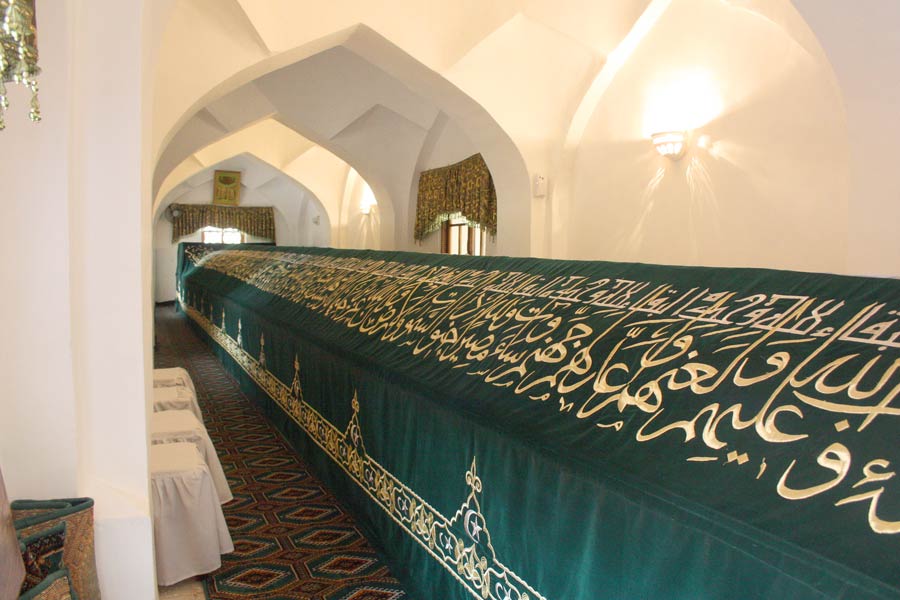
Mausoleum of Daniel Prophet
Among the hills of Afrosiab, on the river-bank of small rivulet Siebcha (confluent of Zerafshan), there is a miracle place, the blessing of which can be nearly physically felt. The complete calm prevails there, even birds preserve it. Here is situated the Mausoleum of Saint Daniel. Among the scientists, there is still no agreement about when and how the mausoleum of the biblical prophet Daniel appeared in Samarkand. It is respected holly place by representatives of three world religions Islam, Judaism, and Christianity. A long 5-dome building of the mausoleum stretched on the high cliff of the hill, and the Siab River flows at the foot of the hill. The stretch of the building is directly connected with the tombstone, whose length is 18 meters. Many legends and hypotheses are associated with this grave. Some claim that the remains were brought here by early Christians, others tend to think that they were ordered to be delivered to Samarkand by the famous medieval ruler Amir Timur (Tamerlane). There are also disagreements between what is in the grave: some sources say that the hand of Saint Daniel is buried here, others contradict, and argue that only a handful of earth was brought here from the grave of the saint. The third contradiction is related to the identity of the remains, where two persons appear: the first is the prophet Daniel, the second is Khoja Doniyar, an associate of Kusama ibn Abbas (Shahi-Zinda). There are also stories about the size of the grave. According to one interpretation, the holy relics grow from year to year. Another argues that the grave is made large so that no one can accurately locate the remains of the remains, and steal them. Be that as it may, this mausoleum, being away from other sights of Samarkand, attracts a huge number of pilgrims from many nations and religions. But it’s not necessary to be a believer to feel calm and pacify this place.