
 3, Pushkin str., Samarkand 140100 Uzbekistan
  +998 90 655 05 00
  info@sacredeasttravel.com


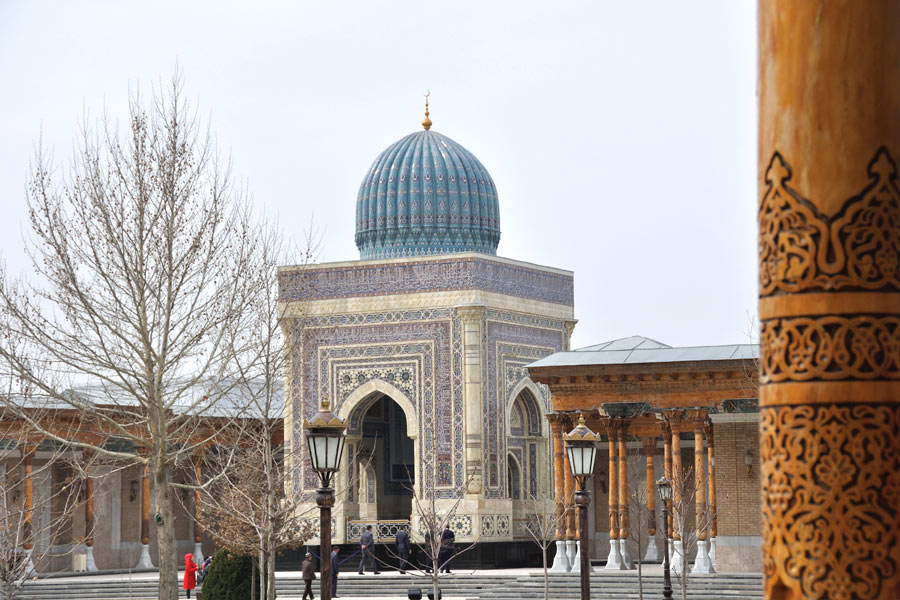
Imam al-Bukhari mausoleum
In the village of Hortang for (25 km from Samarkand) is one of the most revered places of pilgrimage in Islam – the mausoleum of Imam al-Bukhari. Abu Abdullah Muhammad ibn Ismail al-Bukhari is a famous theologian, scholar of the hadith (hadithology – the science of hadiths, reports about the statements and deeds of the Prophet Muhammad) and the author of the second most important book after the Qur’an, Al-Jomii al-Saheeh (” collection “). Imam Al-Bukhari was born in 810 in Bukhara. It is known that his great-grandfather was one of the first who accepted Islam. His father was one of the storytellers of the sacred traditions. When Al-Bukhari was still a child, his father died. Al-Bukhari remained in the care of his mother, who brought him up. She was an educated woman who organized the boy’s training in various sciences. Muhammad was perceptive, intelligent, possessed an extraordinary memory for his age. At the age of 7 he studied the entire Koran, at the age of 10 he knew several thousand hadith by heart. In 825 when he was 16 years old, al-Bukhari with his mother and elder brother Ahmed went to Hajj to Mecca and Medina. After the pilgrimage, the mother and her brother returned to Bukhara, and for many years he traveled to various Muslim countries, where he studied with well-known theologians of that time.
According to legend, he collected hundreds of thousands of hadith, 300 thousand of which he knew by heart. In these studies, he spent 42 years of his life. He started writing his book in Basra and continued to write it for many years, which, according to him, included the hadiths from 1080 experts. His book includes 7275 authentic hadiths. The reliability indicator of the hadeeth is the reliability of the transmission channel and each of its links, implying the moral appearance of the transmitter, allowing it to rely on. Al-Bukhari attached particular importance to identifying the persons who served as the source of the transfer. In the “trustworthy” he referred only those hadiths that were told by people who were directly witnesses to the deed of the prophet. Imam al-Bukhari worked on his book for sixteen years.
According to sources it is known that he wrote many more books, among them “Tarihi Kabir” (“The Great History”). After writing “Al-Sahih” he returns to Bukhara, and begins to teach all those who wanted to study, because he believed that collective education of people to literacy will be of great benefit to society. His authority was so high that the hadeeth, unfamiliar to him, became popular among the people as unreliable. In addition to his will, he came into conflict with the ruler of Bukhara, Tahirid Kholid ibn Ahmad, and was forced to move to the village of Khartang near Samarkand, where he died in 870. The cemetery in the village of Hartang Paiarik fog of Samarkand province has become the most venerated and sacred place for pilgrimage. In the 16th century, near the mausoleum of Imam al-Bukhari, a small mosque was built and plant trees were planted.
In the Soviet period, this sacred place for Muslims was consigned to oblivion, and services were not carried out here. Gradually the mosque was decrepit, but in 1954 it was destined to return to life thanks to the visit of the Indonesian President Sukarno. After a visit to Moscow, President Sukarno arrived in Tashkent and asked him to be allowed to bow to the remains of the holy Imam al-Bukhari. Republican authorities, hearing this, at first were even bewildered, because they had already forgotten who Imam al-Bukhari is and where his grave is. In a hurry, a command was given: immediately send a commission to Samarkand. The authorities could not refuse President Sukarno, because at that time, on the initiative of N.S. Khrushchev, the Soviet Union began to establish international relations with many countries, including the countries of the Islamic East, and therefore the refusal threatened an international scandal. But when the officials came to the scene, they saw an extremely unsightly picture: the mosque was abandoned and on the grave of al-Bukhari there is not even a tombstone. And now, at the command of the high authorities, during the day, the mosque and the adjoining plot, as they could, were put in order, even the asphalt track was hastily put to the mosque. In short, the mosque of Al-Bukhari took President Sukarno. And he, bowing to the grave of the great scientist and honoring his memory, left. Following President Sukarno, the President of Somalia, Madib Keith, arrived in the Soviet Union and also visited Tashkent and asked him to visit the grave of Saint Ismail al-Bukhari. After this, apparently by command from the center, the mosque of Ismail al-Bukhari was transferred to the administration of the Spiritual Administration of the Muslims of Central Asia and Kazakhstan. And since that time the mosque was visited again by the worshipers.
In his opinion, religion and sacred books were created for the moral perfection of man. “No man was created for religion, but religion for man” – this statement was bold for that time. It called for being responsible for peace and order in the world, actively participating in ensuring the prosperity of the country. The scientist had a large number of followers, disciples. Among them, many statesmen, poets such as Zahiriddin Muhammad Babur, the founder of the Great Mogul state, Dzhanibek Sultan (who subsequently gave him the picturesque Miankal island), representatives of the royal dynasty of the Sheybanids.
It should be noted that visiting these holy places among Muslims is equated with a small Hajj. It’s not for nothing that people say: “If Mecca is the heart of the Muslim world, then Samarkand is his head!”.